
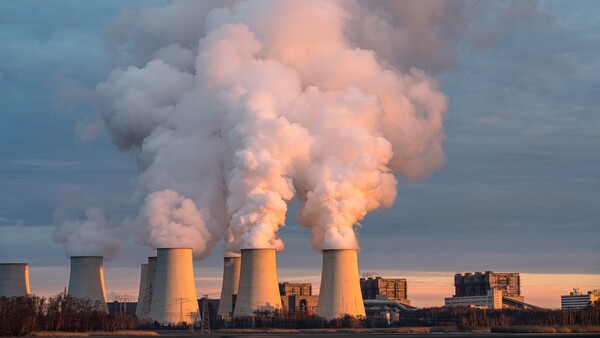
U.S. data center developers expanding AI infrastructure are increasing construction of their own natural gas-fired power plants to address power shortages. The approach can shorten the time needed to connect to the grid, but it is also raising concerns it could increase greenhouse gas emissions and drive up electricity bills.
MIT Technology Review reported on Nov. 24 that energy market research firm Cleanview counted more than 100 on-site fossil-fuel power projects at U.S. data centers as of October this year, with total installed capacity exceeding 115 gigawatts (GW). That is more than twice California's peak power demand.
Cleanview's latest tally put the number of projects at 120, with total installed capacity rising to 129 GW. Actual operating capacity as of October was only 4.9 GW, while 15.8 GW was under construction, leaving it uncertain whether all projects will be realised.
The trend is being driven by delays in grid connections. For data centers that consume large amounts of electricity, it can take up to 10 years to connect to the grid because of constraints in expanding infrastructure such as transmission lines and transformers. Developers are therefore adopting behind-the-meter (BTM) generation, producing power directly on site even at higher cost.
A key issue is that reliance on fossil fuels could deepen. BloombergNEF (BNEF) estimated planned global construction of data center on-site fossil-fuel plants at 181 GW, with more than 90 percent concentrated in the United States.
BNEF estimated that if all U.S. plans are carried out, annual greenhouse gas emissions would reach 345 million tonnes in carbon dioxide equivalent terms. That would be 152 million tonnes more than supplying power to the same data centers through the U.S. grid.
The economic burden is also significant. The Rocky Mountain Institute (RMI) estimated that grid usage costs for large U.S. power consumers range from $55 to $115 per megawatt hour (MWh), compared with estimated costs of $100 to $165 for self-generated fossil-fuel power.
Experts said expanding self-generation at data centers could increase natural gas demand and lift fuel prices, adding to electricity bill burdens for ordinary consumers. With rapid growth in the AI industry, securing stable power supplies while cutting carbon is emerging as a key task.
 Jae-won Choi
ittt_0801@d-today.co.kr
Keyword
#MIT Technology Review #Cleanview #BloombergNEF #Rocky Mountain Institute #Behind-the-Meter
