
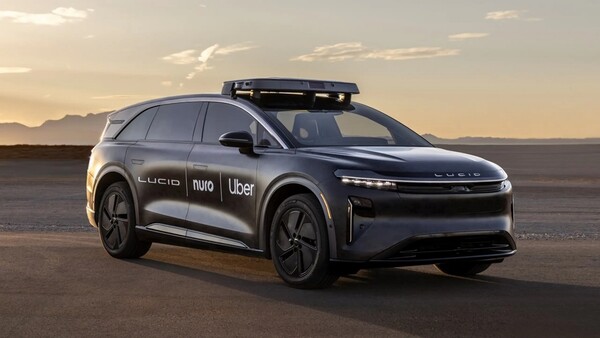
[Digital Today reporter Jae-won Choi (최재원)] U.S. electric vehicle maker Lucid is joining forces with ride-hailing platform Uber and self-driving technology company Nuro to speed up the commercial launch of fully driverless robotaxis. Attention is on whether Lucid, which has struggled to expand EV sales, can secure the robotaxi business as a new growth engine.
InsideEVs reported on Nov. 24 that Lucid, Uber and Nuro began fully driverless road tests of a robotaxi based on the Gravity, a large electric sports utility vehicle, on public roads in the San Francisco Bay Area.
Nuro has conducted autonomous driving tests with safety personnel on board in the San Francisco Bay Area and Houston since December last year. This time, it is operating without an in-vehicle safety supervisor for the first time. The initial test area covers four cities: Palo Alto, Mountain View, Los Altos and Sunnyvale, and the companies plan to expand the test scope from 2027.
Lucid supplied about 100 Gravity vehicles with improved hardware and software for the project. The three companies plan to offer driverless ride services to employees soon and then start commercial service for general passengers in the first quarter of 2027. The service launch, initially scheduled for this year, was pushed back to the following year.
Lucid is responsible for supplying vehicles, Nuro for Level 4 autonomous driving technology, and Uber for the platform and vehicle operations. Passengers will be able to hail robotaxis through the existing Uber app without a separate app. Uber agreed to buy at least 35,000 robotaxis, including Lucid’s mid-size electric car to be released later.
Gravity’s strengths are long driving range and fast charging. The standard passenger model can travel up to 450 miles, or about 724.2 km, on a single charge. With 400-kilowatt charging, it can add 200 miles, or about 321.8 km, of range in 11 minutes. That reduces downtime from charging and helps improve robotaxi operating efficiency.
Still, the high vehicle price is a burden. The standard Gravity starts at $81,750, or about 110.12 million won, and the price of the robotaxi-only model, as well as changes in power efficiency and driving range from adding autonomous driving equipment, were not disclosed. Expanding vehicle supply and securing operating profitability are expected to determine the success of Lucid’s robotaxi business.
 Jae-won Choi
ittt_0801@d-today.co.kr
Keyword
#Lucid #Uber #Nuro #San Francisco Bay Area #Gravity
