
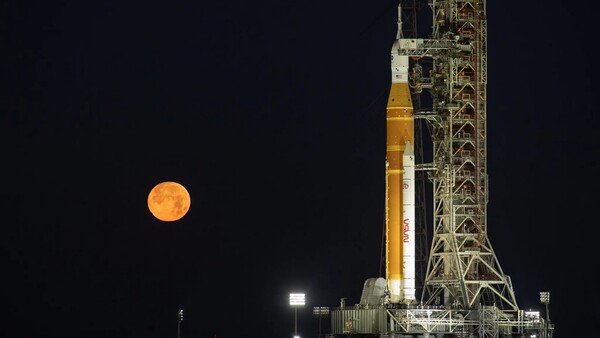
[Digital Today reporter Choi Jae-won] The U.S. White House is pushing to increase the budget for NASA's crewed lunar exploration programme Artemis. With competition with China for dominance in space intensifying, it aims to resolve issues in lunar lander development and key component supply chains and move up the timeline for humanity's return to the moon.
On Nov. 24, the IT outlet Ars Technica reported that the White House, in a document requesting exemptions related to a stopgap budget submitted to Congress the previous day, asked to raise Artemis' annual spending level to $9.783 billion from $7.783 billion, a 25.7 percent increase.
The U.S. federal government began fiscal 2027 on Oct. 1, but federal agencies including NASA are operating under a stopgap budget after Congress and the White House failed to agree on a full budget. The current stopgap budget expires on Dec. 11.
The main goal of the funding increase is to ease technical and industrial bottlenecks in Artemis. NASA is supporting supply-chain stabilisation and testing for crewed lunar landers being developed by SpaceX and Blue Origin.
Support also targets Axiom Space's lunar exploration spacesuit and the development of power and communications equipment needed to build a lunar base.
The White House also called for strengthening NASA's own capability to produce parts. It said development and production systems for spacesuits and engines, Space Launch System-related equipment, habitation modules and astronaut safety systems need to be modernised. The move is seen as aimed at minimising disruptions caused by delivery delays from private suppliers.
NASA plans to verify docking and operational technologies in 2027 through the Artemis 3 mission, between the Orion spacecraft in low Earth orbit and test versions of lunar landers from SpaceX and Blue Origin. It then aims for a crewed lunar landing through Artemis 4 in 2028.
The request is also expected to support a strategy to accelerate lunar exploration promoted by NASA Administrator Jared Isaacman (재러드 아이작먼).
The White House request seeks to raise the annualised cap for budget execution and does not mean an immediate additional payout of $2 billion. Whether the budget is actually expanded depends on congressional approval.
 Choi Jae-won
ittt_0801@d-today.co.kr
Keyword
#White House #NASA #Artemis #SpaceX #Blue Origin
