
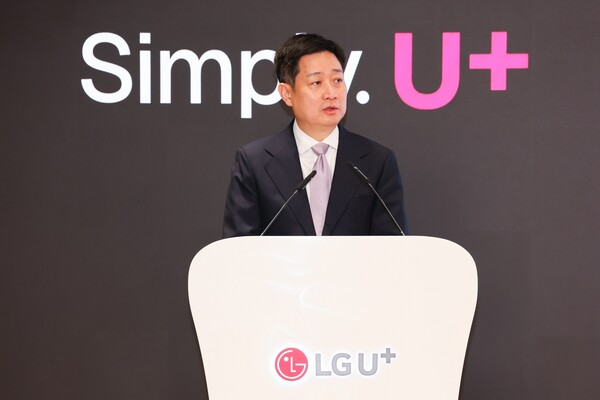
Hong Beom-sik (홍범식), CEO of LG Uplus, has been renewed in his post and will enter his third year of management next year. Hong, who has led improved performance by making the business structure more efficient since taking office, is expected to step up efforts to deliver results in the AI business next year. Securing a growth base through large-scale investment in AI data centers and strengthening information security are seen as key tasks for him.
On Nov. 25, the telecommunications industry said LG Group recently decided to maintain Hong's leadership of LG Uplus through its regular executive reshuffle for 2027. Hong, who took the helm of LG Uplus at the end of 2024, is a strategy expert within the group, having served as head of Bain & Company Korea and as head of LG's management strategy division.
The reshuffle is aimed at ensuring continuity in the business strategy Hong has pursued over the past two years and at supporting a shift to an AI-centered business portfolio. LG Uplus also carried out a total of 11 promotions, including 2 to executive vice president and 9 new managing directors, focusing on strengthening execution in the AI business and competitiveness in wired and wireless telecommunications.
In the past two years, Hong's results have stood out in performance. Despite slower growth in the telecoms market and the burden of investment in new businesses, the company achieved both top-line growth and improved profitability. Last year, LG Uplus' annual consolidated revenue was 15.45 trillion won, up 5.7 percent from a year earlier. Operating profit also rose 3.4 percent to 892.1 billion won, marking a rebound.
This year, the trend of improving profitability has become clearer. Cumulative operating profit through the third quarter was 914.4 billion won, already surpassing last year's full-year operating profit. A return to operating profit in the 1 trillion won range is now within reach. Industry observers say Hong's return-on-investment-focused management approach is being reflected in results. Improving operational efficiency in existing businesses and concentrating resources on higher-growth areas have been paying off.
Work is also continuing to strengthen the growth base of the core telecoms business. As of the end of the third quarter, LG Uplus' total mobile subscription lines stood at about 32,143,000, up 6.2 percent from a year earlier. Its smart home business, including high-speed internet and IPTV, is also maintaining growth.
The company's global expansion strategy also delivered its first results this year. LG Uplus signed a contract in May with Malaysia's telco Maxis to launch its AI call service, ixi-O, commercially in the local market. It was the first case of exporting its in-house AI software overseas.
Hong said, "Based on the AI experience accumulated in Korea, we will work to expand the global market centered on AI software as a service." The plan is to provide functions proven in Korea, such as call recording and summarization and real-time voice phishing detection, in a software-as-a-service format tailored to local telecoms environments.
A key keyword for Hong's third year is monetising the AI business. After pursuing a shift to an AI-centered business structure over the past two years, it is now time to prove results in concrete revenue and profit.
At MWC26 held in Barcelona, Spain, in March, Hong presented 'a global AI software company' as LG Uplus' mid- to long-term vision. The plan is to move beyond the domestic-focused telecoms business and turn technologies secured in adjacent areas into solutions to target overseas markets.
The area LG Uplus is investing in most aggressively is AI data centers. Third-quarter revenue from AI data centers was 131.7 billion won, up 27.7 percent from a year earlier. Supported by growth in AI data centers, revenue from the corporate infrastructure division also posted a double-digit growth rate.
Next year is set to be the year when the large-scale AI data center investment pursued by Hong begins to bear fruit. LG Uplus is building an AI data center with 200 megawatts of receiving capacity in Paju, Gyeonggi province. It will complete the first building with 50 megawatts of capacity in June next year and sequentially bring a total of four buildings online by 2028.
LG Uplus decided at a board meeting on Nov. 19 to make an additional investment of 789.0 billion won for the third phase of the Paju AI data center construction. Combined with the 615.6 billion won first-phase investment decided in April last year and the 1.35 trillion won second-phase investment approved in July this year, the total investment will reach 2.75 trillion won.
A telecoms industry official said, "LG Uplus made a preemptive investment by starting construction of the Paju AI data center ahead of other companies," and added, "It is meant to prepare in advance for AI computing demand."
The company is also seeking new revenue sources in software. LG Uplus will expand its AI contact center business to the financial sector and other areas, while pushing from next year to commercialise token optimisation technology that reduces costs incurred in operating AI services. It is also working to expand enterprise AI services using its own AI models and LG AI Research's EXAONE, among others.
Strengthening security remains an outstanding task. Despite improved performance and expansion of the AI business, addressing information security risks related to a hacking controversy that emerged last year is a task that must be resolved in particular.
The Personal Information Protection Commission announced in July the results of its investigation into LG Uplus' personal information leak incident. It confirmed that the personal information of employees and partner company workers leaked externally was information managed in LG Uplus' integrated password management system.
However, there were limits in confirming the exact circumstances of the leak because the operating system of the related server was reinstalled or the server was scrapped. Earlier, the Ministry of Science and ICT also took issue with the scrapping of the related server and requested a police investigation in December last year. Police are currently investigating the matter.
The company must also respond to new security threats arising from the expansion of the AI business. Given the business characteristics of AI services that use customers' call data and AI data centers and AI contact centers that process data from external companies, information security capability is directly linked to business competitiveness.
LG Uplus is working to strengthen security by expanding information security investment. According to an information security white paper the company published this year, last year's information security investment was about 96.6 billion won, up 17 percent from a year earlier. Over the past five years, the scale of information security investment has increased 3.3 times.
Group companies also placed emphasis in this regular executive reshuffle on strengthening business execution while securing a sustainable growth base. Hong, who has focused on business efficiency and improved performance since taking office, plans after being renewed in his post to pursue in parallel stronger competitiveness in the core telecoms business, expansion of the AI business and enhanced information security capabilities.
 Jin-ho Lee
jhlee26@d-today.co.kr
Keyword
#LG Uplus #LG Group #Paju #Personal Information Protection Commission #EXAONE
