
A diagnosis said a social perception that views finance as a policy tool rather than an independent industry lies behind why South Korean finance has failed to stand out in global financial markets despite having world-class technology and service competitiveness. It also said negative views of financial firms’ pursuit of profit and limits on management autonomy are hindering the financial industry’s growth and innovation.
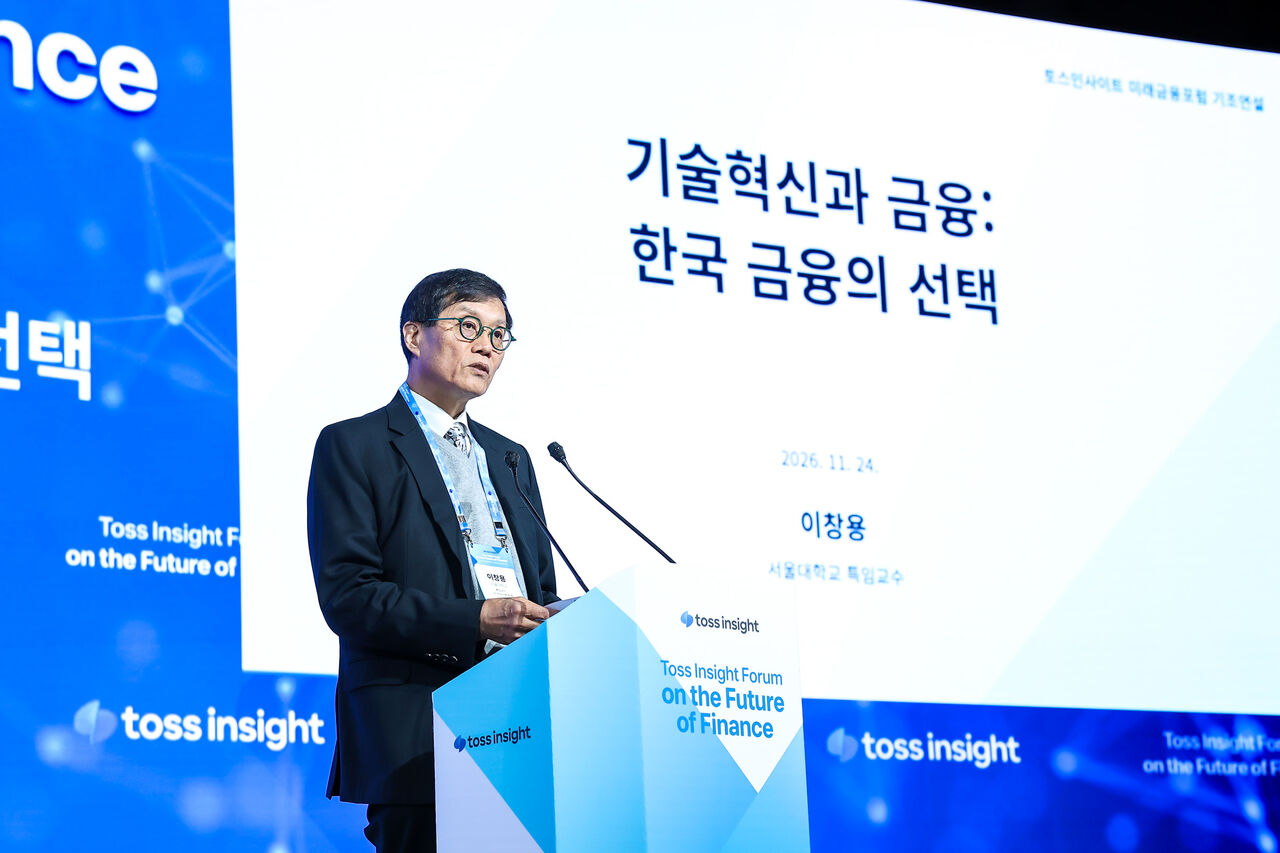
Toss’ financial management research institute, Toss Insight, held the Toss Insight Forum on the Future of Finance on Nov. 24 at the Westin Josun Seoul. The forum was set up for experts from academia, financial institutions, fintech companies and policy authorities to discuss how technological innovation is changing the financial industry and its direction for development.
Former Bank of Korea Governor Lee Chang-yong (이창용), now a special-appointed professor at Seoul National University, delivered a keynote speech on “Technological Innovation and Finance: Choices for South Korean Finance.” He said finance’s social responsibility is important, but stressed that if finance is seen only as a target of control, growth and innovation in the financial industry itself will inevitably be constrained.
Lee said South Korea has already reached an advanced-economy level in financial technology and services, but its overall international competitiveness in the financial industry falls short of that.
As of March this year, the average price-to-book ratio and price-to-earnings ratio of major domestic banks were 0.7 and 7.4, respectively, far below 2.0 and 15.6 for major U.S. banks.
Lee cited social perceptions of the financial industry and South Korea’s specific conditions that have constrained capital liberalisation and internationalisation of the won as reasons for the gap.
He pointed in particular to a strong tendency in South Korea to link finance’s public nature to support for the real economy and vulnerable groups, while viewing financial firms’ pursuit of profit and overseas expansion negatively. He also saw banks’ reliance on real estate-backed loans, rather than assessing and taking on risks in new industries, as a limitation of such financial practices.
Lee said that if policy demands on management increase and executive replacements become frequent, it becomes difficult to accumulate the expertise and experience of a chief executive. He said overseas market development, which requires long-term investment and a consistent strategy, will inevitably be further discouraged.
He also stressed that South Korea should not keep repeating slogans about nurturing finance as a high value-added industry that competes globally, while viewing it only as a policy tool.
He said a cautious approach is needed on capital liberalisation and internationalisation of the won. If geopolitical risks related to North Korea rise, large-scale outflows of overseas funds could shock the domestic economy, he said.
He explained that his push, when he was Bank of Korea governor, for banks to issue won stablecoins through a consortium was intended to manage capital-movement risks through the existing financial supervisory framework.
Toss Insight chief executive Byung-doo Sohn (손병두) said in opening remarks that the gap between technological innovation and institutions must be narrowed.
He said the boundaries of the financial industry and the competitive order are being reshaped as AI and data, digital currency and tokenised assets combine, but organisations and institutions are not keeping up with the pace of change.
Sohn cited key institutional tasks including AI decision criteria and responsibility in the event of incidents, personal information protection, and the safety and redeemability of reserve assets for stablecoins.
Sohn said what is needed is to maximise the potential of technology while designing concrete principles and operating methods to control its risks. He said good institutions should not be barriers standing in opposition to innovation, but a foundation for innovation to spread more widely and last longer.
The forum also discussed changes in industrial structure and policy response directions arising from financial innovation, including AI and blockchain, MyData, stablecoins, deposit tokens and asset tokenisation.
 Ji-young Lee
ljy@d-today.co.kr
Keyword
#Bank of Korea #Toss Insight #Westin Josun Seoul #PBR #PER
