
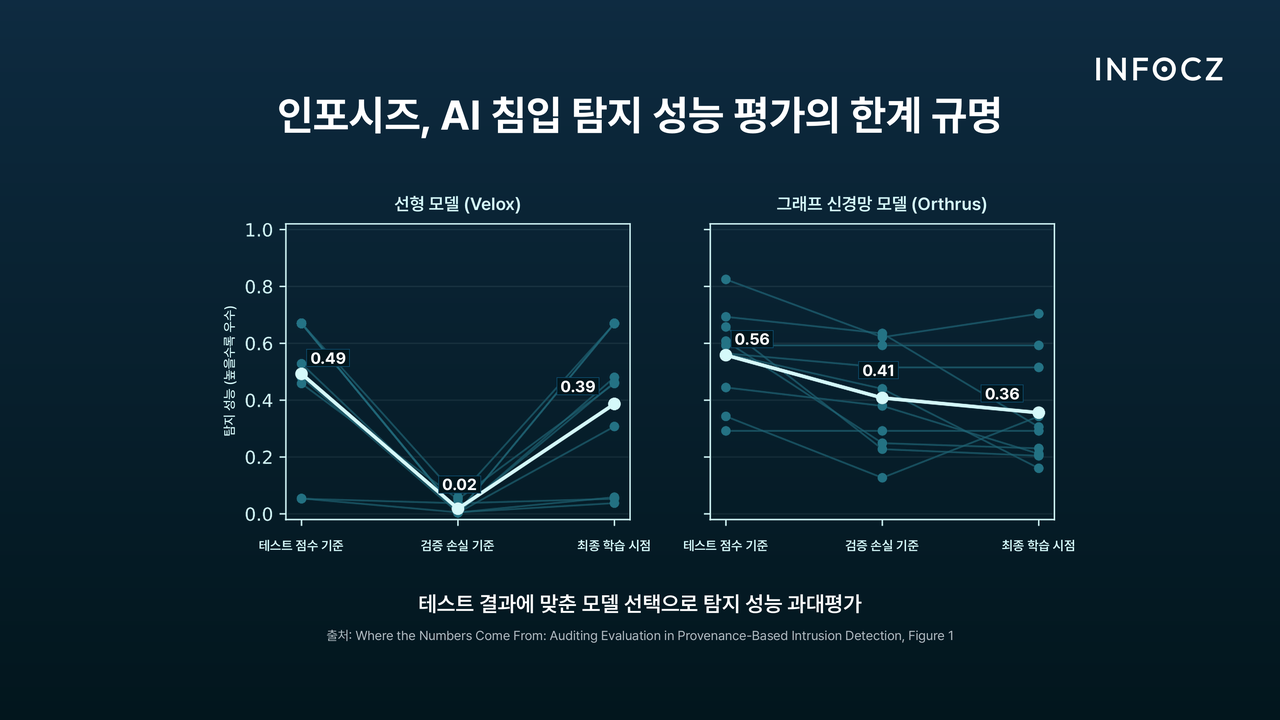
Infoseeds, an ontology-based enterprise AI company, said on Nov. 24 that the development team for its AI security solution GOS (Graph Optimized Security) published a paper disclosing results of its verification of existing performance evaluation methods for AI intrusion detection models.
The company said the research confirmed that performance figures can vary significantly depending on the evaluation method.
GOS researchers analyzed nine AI-based advanced persistent threat (APT) detectors with publicly available code. They directly ran four of them using the original authors' code to verify problems that arise in the performance evaluation process. The verification used public data including a U.S. Defense Advanced Research Projects Agency (DARPA) cybersecurity dataset, and conducted repeated tests under a total of 138 conditions.
The experiments found factors that could undermine the reliability of performance evaluations, including evaluation methods that count alerts generated around an attack point as correct, use of test data ground-truth information for model selection, and implementation flaws in the processing of graph data.
An analysis of 994 alerts from the intrusion detection model ThreaTrace found that precision was 93.8 percent when using an evaluation method that counts nodes near an attack node as correct. By contrast, when only cases that exactly matched actual attack labels among the same alerts were counted as correct, only 7 were classified as correct.
Some models were found to use test data ground-truth information to select the optimal model or detection threshold. In evaluations that did not use that information, attack detection precision (ADP) fell by 0.16 to 0.33 points. A defect was also confirmed in code that processes graph connection information, in which unintended information was fed into the model.
To address these issues, the researchers proposed STRICT, six verification methods designed to evaluate AI intrusion detection performance consistently and transparently. STRICT consists of strict attack label matching (S), performance reporting by alert budget (T), repeated training (R), model selection independent of test data (I), chronological data splitting (C), and disclosure of experiment scores (T).
Moon Ji-hwan (문지환), an applied scientist on Infoseeds' GOS development team, said, "While various AI security models are emerging, standards for how to evaluate their performance have not yet been sufficiently established." He added, "What matters in AI security technology is not high accuracy itself, but verifying how accurately real attacks are detected and whether the technology can be used in the field. We need to thoroughly verify not only technical performance but also evaluation methods to build a reliable AI security system."
 Chi-gyu Hwang
delight@d-today.co.kr
Keyword
#Infoseeds #GOS #DARPA #ThreaTrace #STRICT
