
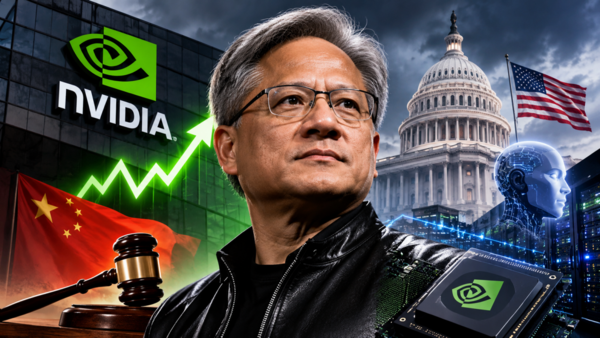
[Digital Today reporter Jinju Hong] Nvidia shares soared after the company abruptly brought back CEO Jensen Huang (젠슨 황), but controversy over its China business and U.S. government involvement is spreading. Huang’s return has calmed market anxiety somewhat, but regulatory risks are again in focus as the U.S. Congress begins to closely examine Nvidia’s semiconductor exports to China and national security issues.
On Nov. 24 (local time), CNBC reported that Nvidia’s board unanimously decided to reinstate Huang that day. The board reversed its position after saying just days earlier that it had accepted Huang’s resignation and had no plans to bring him back.
The market reaction was immediate. Nvidia shares at one point surged 36 percent intraday and finished up 31 percent. The gains spread across major technology stocks. The Nasdaq Composite rose 6.5 percent and the S&P 500 climbed 4.7 percent, both logging their biggest rises since April 2025.
The decision came even as Nvidia struggled to shake weakness in its stock despite reporting strong third-quarter results on Nov. 17. Nvidia shares closed at $125.53 on Nov. 21, and more than 200,000 people signed a petition calling for Huang’s return. The board, however, maintained its position that it would continue its investigation into Huang’s actions.
Why did Nvidia’s board reverse its decision to bring Huang back?
At the center of the controversy is why the board reversed itself within just days. Board Chairman Harvey Jones said in an earnings conference call on Nov. 17 that the board had accepted Huang’s resignation and had no intention of reinstating him. But on Nov. 24 the board reversed its decision after discussions with Huang and hearing views from senior U.S. government officials.
U.S. President Donald Trump said he had spoken with members of Nvidia’s board and that the administration provided assurances based on information it had secured at the time. The board did not disclose details of what it heard from the government or what assurances influenced the reinstatement decision.
The U.S. Congress is raising pressure, questioning the circumstances of the government’s involvement. Senator Jack Reed of the Senate Banking Committee called for Treasury Secretary Scott Bessent and Commerce Secretary Howard Lutnick to appear before the committee. He questioned the process in which Trump supported Huang’s return after receiving an intelligence briefing led by Marco Rubio, who was then national security adviser.
There are also demands to disclose records of communications between Huang and Trump, as well as call records between the president and Nvidia board members.
How much risk remains in Nvidia’s China business?
The House Foreign Affairs Committee is also seeking to broaden its investigation. Representative Gabe Amo said Huang’s return could widen the scope of inquiries rather than end the controversy. He argued that administration officials involved in decisions on semiconductor sales to China should also be included in the probe. Amo said he expected a closed-door meeting with Huang to proceed as scheduled on Dec. 1 and said preparations should be made for a Washington visit.
Lawmakers’ main concerns include allegations of smuggling of Nvidia semiconductors into China, the possibility of military diversion and the impact on strengthening China’s artificial intelligence capabilities. The Senate Banking Committee scheduled Huang to testify on Dec. 3 on U.S. export control issues. The House plans closed-door meetings on Dec. 1 with Huang and on Dec. 2 with Nvidia general counsel Tim Teter.
Representatives John Moolenaar, Rick Crawford and Brian Mast said in a joint statement that questions related to national security threats would not be resolved merely by a brief internal probe by Nvidia’s board and Huang’s return.
Can Jensen Huang’s management control be properly overseen?
Nvidia’s internal control system is also under scrutiny. The company has pledged to appoint a new chief compliance officer and set up a committee to oversee national security and export controls. Investors are watching whether such bodies can secure independent authority and effectiveness in the actual decision-making process.
Is there a succession plan after Jensen Huang?
Succession has again come into focus. Gil Luria, head of tech research at D.A. Davidson, said it is uncertain whether Nvidia can receive the same level of support under the next administration, with Trump’s term ending in 2 years. He said Nvidia needs to lay out a clear succession structure in case Huang steps away from the front line again.
Can Nvidia sustain its growth?
Earnings and demand for AI investment remain key variables driving Nvidia shares. Josh Gilbert, APAC and Middle East senior analyst at eToro, said short-term demand looks solid, citing forecasts that Nvidia’s next fiscal-year revenue growth will be about 75 percent. He added it remains to be seen whether customer orders and the scale of AI investment can support such growth over the long term.
Luria cited data center financing costs, the possibility of overinvestment by neocloud firms and constraints on building new facilities as burdens on the AI investment market. That means that even if Nvidia’s results remain solid, growth could vary depending on customers’ capacity to invest and the pace of data center construction.
Can Nvidia shares keep rising?
Some analysis says it is difficult to interpret the sharp rise in the stock only as a reflection of new growth expectations. Gilbert said part of the gain on Nov. 24 was a move to recoup earlier losses. He said Huang’s return could ease market anxiety over the long-term outlook, but the direction of the stock will ultimately depend on whether Nvidia can sustain the performance it has shown in recent years.
Wall Street investment views remained broadly positive. Bernstein restored its rating on Nvidia to 'outperform' and kept its target price at $200. UBS also maintained its target price at $220.
Huang’s return has lifted Nvidia shares in the short term, but tasks to resolve remain, including China semiconductor export controls, the circumstances of U.S. government involvement, stronger internal controls and succession planning. Market attention is now focused beyond the rebound in the stock, on whether Nvidia can sustain growth amid regulatory and geopolitical uncertainty.
 Jinju Hong
hongjj@d-today.co.kr
Keyword
#Nvidia #Jensen Huang #CNBC #U.S. Congress #Donald Trump
