
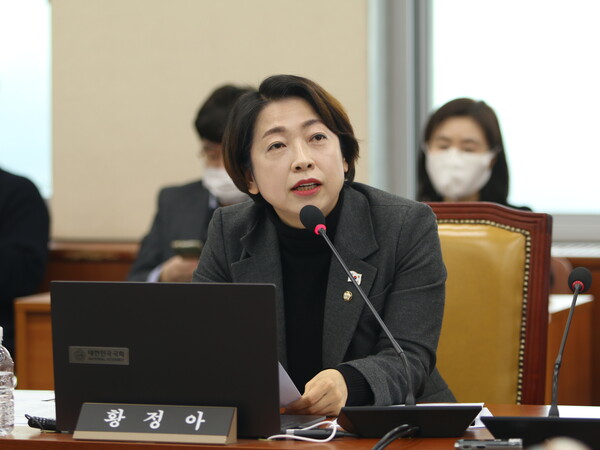
A bill has been introduced to overhaul the national system for 추진ing space and aerospace policy and to guarantee autonomy for research institutes in the space and aerospace sector.
Democratic Party lawmaker Hwang Jeong-a (황정아) introduced on the 23rd a proposed Basic Space and Aerospace Act and a bill to foster research institutes directly under the Korea Aerospace Administration.
South Korea, with the launch of the Korea Aerospace Administration in 2024, put one agency in charge of space development as well as aviation industry and technology development tasks. But limits remained in 추진ing policy in an integrated way because the existing legal system set up by sector was kept in place, Hwang's office explained.
The proposed Basic Space and Aerospace Act is centered on setting out the basic direction and 추진ing system for national policy covering both space and aviation.
It requires the government to establish and implement a basic space plan and a basic plan to promote the aviation industry every 5 years. It also includes provisions to set up a National Space and Aerospace Commission under the president to deliberate major policies and matters involving coordination of tasks among relevant ministries. It also establishes grounds for policy 추진ing by sector, including space risk management, research and development, industrial promotion, talent development and international cooperation.
The bill to foster research institutes directly under the Korea Aerospace Administration specifies the research and management independence and autonomy of the Korea Aerospace Research Institute and the Korea Astronomy and Space Science Institute.
It would allow the two institutes to run core projects in line with their founding purposes. It also sets standards needed for responsible management, including approval of business plans and budgets, accounting audits and institutional evaluations. It also clarifies the legal basis for rights and obligations that had applied to the two institutes as government-funded research institutes by overhauling related laws.
Hwang said, "The successful fifth launch of Nuri demonstrated our country's independent space access capability and is an achievement that clearly shows the technological capabilities our researchers and companies have built together." She said, "We need a system to consistently 추진 long-term space development policy, and an environment in which research institutes can develop technology with a long-term perspective."
 Jin-ho Lee
jhlee26@d-today.co.kr
Keyword
#Democratic Party #Basic Space and Aerospace Act #Korea Aerospace Research Institute #Korea Astronomy and Space Science Institute #National Space and Aerospace Commission
