
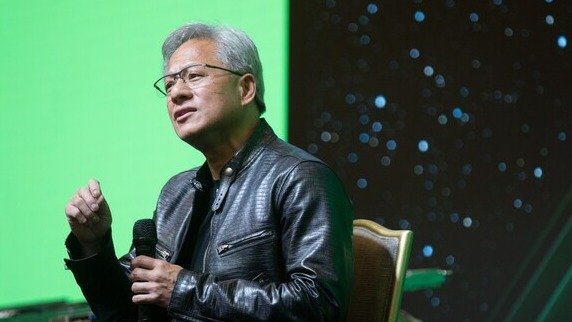
Jensen Huang has returned as Nvidia's chief executive, but suspicions over semiconductor leaks to China and national security controversy surrounding the company remain unresolved. U.S. authorities are examining issues ranging from indications of contacts with Chinese intelligence agencies by a person linked to Huang to the possibility that Nvidia chips were distributed through third countries. Political pressure for an investigation is also growing.
On Nov. 23, local time, major foreign media outlets including IT publication TechCrunch and blockchain outlet Cryptopolitan reported that U.S. authorities are investigating alleged ties to China's Ministry of State Security involving Alice Huang, who is known to have had a relationship with Jensen Huang, and her business partner Kangwei. The New York Times reported that Alice Huang was in sustained contact with officials linked to the Ministry of State Security even during the period she maintained her relationship with Jensen Huang. It has not been confirmed whether they actually worked for Chinese intelligence agencies or what specific information they exchanged.
The focus of the investigation is expanding to semiconductor transactions by Megaspeed, a company run by Alice Huang. Megaspeed imported large volumes of high-performance artificial intelligence processors, and some of the shipments were identified as moving to Southeast Asian computing centers held by Chinese companies including Alibaba. This has raised the possibility that restricted chips entered China without U.S. export approval.
U.S. intelligence authorities are also looking into indications that Alice Huang and Kangwei operated their business through corporate entities in multiple regions. With some related companies reported to have supplied materials to China's People's Liberation Army, investigators are also examining whether restricted computing resources flowed to customers linked to the military. There has been no conclusion that the chips were actually used for military purposes.
The U.S. administration and Congress are also watching the matter. Donald Trump received a prior briefing on the suspicions, and was also reported to have heard warnings from Secretary of State Marco Rubio about possible links between Alice Huang and the Ministry of State Security. Trump said he did not know whether Alice Huang was a spy, but stated that Jensen Huang should be protected as a key U.S. talent.
Nvidia's responsibility for managing chip sales to China has also emerged as a point of contention. Director of National Intelligence Jay Clayton said an investigation is under way targeting Alice Huang and her company, and Treasury Secretary Scott Bessent explained that authorities are examining who was responsible for export-rule compliance and how much Nvidia was aware of related activity.
Jensen Huang and Nvidia legal chief Tim Teter are scheduled to sit for closed-door transcribed interviews on Dec. 1 and 2 before three U.S. House of Representatives committees, respectively. The possibility has also been raised that Democrats may launch a congressional investigation. Huang's return has eased concerns over a management vacuum for now, but possible export-control violations and national security controversy have instead remained a long-term burden for the company. In particular, with Trump's involvement and political funding issues also intertwined, the matter could spread beyond Nvidia into a political dispute over U.S. government policy on technology controls targeting China.
 Jinju Hong
hongjj@d-today.co.kr
Keyword
#Nvidia #Jensen Huang #Alice Huang #Megaspeed #Ministry of State Security
