
[DigitalToday reporter Yoonseo Lee] Anthropic has launched an artificial intelligence (AI) agent called Claude Ship that automates everything from reviewing code changes to fixing errors and approving them.
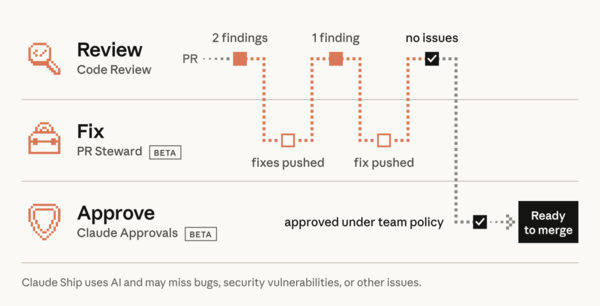
On Nov. 23 (local time), TechCrunch reported that Claude Ship was designed to review code changes posted in GitHub pull requests (PRs), fix problems if found and then automatically approve them in line with development team policies.
Anthropic focused on reducing bottlenecks in the review and approval process before code deployment. As AI coding agents generate more code, developers have more changes to review before release. The plan is to expand Claude's role from writing code to reviewing changes and deciding whether they should be merged.
Claude Ship consists of Code Review, which is generally available, and PR Steward and Claude Approvals, which are offered in beta. Code Review finds issues in proposed changes. PR Steward resolves continuous integration (CI) check failures and merge conflicts and reflects feedback from Code Review. It leaves comments on changes each time code is pushed and, if needed, also explains how to roll back changes.
Claude Approvals automatically approves code changes based on policies that development teams have written as files in a repository. Teams can write approval policies in natural language and can incorporate Code Review results or decisions from a company's own classifier into approval criteria.
Anthropic recommended that, because auto-approvals are in beta, teams run them in observation-only mode before actual approvals. Teams can start applying it in a single repository and can also set what runs, how reviews are conducted and the criteria for changes that require human judgment. It also supports setting a monthly spending cap.
Claude Ship is available to Claude Team and Enterprise plan customers using GitHub repositories. Code Review is available as a general feature, while PR Steward, which handles pull request fixes, and Claude Approvals, which automatically approves changes under team policies, are provided in beta.
The impact in actual use will depend on how much it can reduce review time for repetitive code changes. In beta, another key issue is whether auto-approvals can apply team policies consistently and properly identify changes that require human judgment.
 Yoonseo Lee
yslee@d-today.co.kr
Keyword
#Anthropic #Claude Ship #GitHub #TechCrunch #Claude Approvals
