
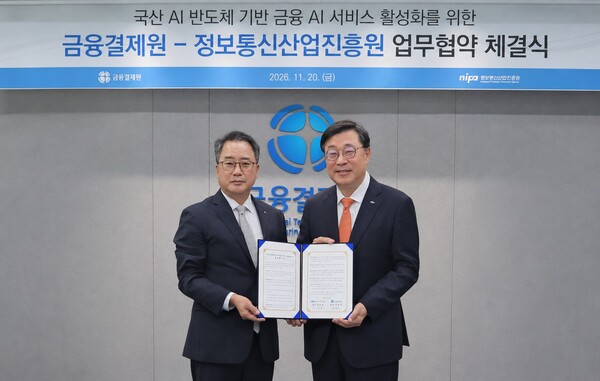
South Korea's National IT Industry Promotion Agency (NIPA) will work with the Korea Financial Telecommunications and Clearings Institute to expand the application and testing of homegrown AI semiconductors in financial services.
NIPA said on Nov. 24 it signed a memorandum of understanding with the institute on Nov. 20 at the institute's headquarters in Seoul to promote financial AI services based on homegrown AI semiconductors.
The agreement aims to secure real-world examples of applying homegrown AI semiconductors to financial services and to verify the performance and stability demanded by the financial sector. The institute is taking part this year as a demand institution in a demonstration project supported by NIPA and is building an anomalous transaction detection platform jointly used by banks based on homegrown AI semiconductors.
The two sides will work together on planning tasks to use AI semiconductors in finance and linking them to government-backed projects, demonstrations of finance-specialised AI models and services, AI technology development and use, and verification of homegrown AI semiconductor performance metrics, known as K-Perf. NIPA will support the development and demonstration of AI transformation (AX) devices, while the institute will provide demonstration targets and sites, operational personnel and other resources.
It plans to apply K-Perf, a performance metric that evaluates processing speed and response time of homegrown neural processing units, to financial settlement operations. The goal is to set objective performance verification standards that financial institutions can use when considering the adoption of homegrown AI semiconductors.
Based on demonstration results in finance, NIPA will support commercialisation and business development, including registering AX devices for public procurement. It will expand use cases for homegrown AI semiconductors to other financial institutions and the public sector.
Park Yun-gyu (박윤규), head of NIPA, said the agreement would help secure demonstration results for AX devices and leading examples of large-scale trials. He said a testing environment combined with the institute's experience in operating financial services would lead to outcomes that the public and customers can feel.
Chae Byeong-deuk (채병득), head of the institute, said it would expand trials linking homegrown AI semiconductors with financial AI technologies and jointly identify AI services that can be used in the financial field.
 Jin-ho Lee
jhlee26@d-today.co.kr
Keyword
#NIPA #Korea Financial Telecommunications and Clearings Institute #K-Perf #NPU #AX
