
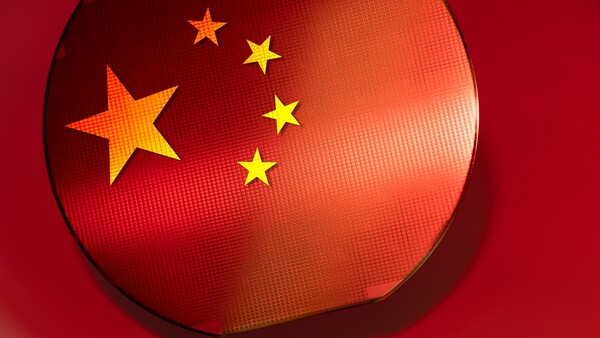
[DigitalToday reporter Jae-won Choi] Chinese memory semiconductor companies are expanding their influence in the global market on the back of government support, large-scale capacity expansion and technological upgrades. Analysts say the possibility of oversupply is being raised in a memory market that has kept growing on an AI boom, which could also affect the pricing power of Samsung Electronics, SK Hynix and U.S. Micron.
The Hong Kong-based South China Morning Post reported on Sunday that China-based ChangXin Memory Technologies (CXMT) and Yangtze Memory Technologies (YMTC) are rapidly expanding production capacity and market share despite U.S. semiconductor export restrictions.
Counterpoint Research said CXMT's global DRAM revenue share in the third quarter rose to 9 percent, up 4 percentage points from 5 percent a year earlier. Revenue for January to September was 269 billion yuan, up 738.5 percent from a year earlier, the report said.
Morgan Stanley forecast CXMT's monthly wafer processing capacity will reach 500,000 wafers by 2028, accounting for about 15 percent of global DRAM production capacity.
The company is also accelerating technology development. CXMT has begun mass production using a fifth-generation process that increases the number of chips produced per wafer by more than 50 percent from the previous process, and it has completed prototype verification using a next-generation 4F-squared structure.
In NAND flash, YMTC ranked third globally in the second quarter with a 16.5 percent share by shipments, surpassing Japan's Kioxia. Its Xtacking technology, which makes memory cells and control circuits on separate wafers and then combines them, is cited as a key competitive strength.
Still, Chinese companies continue to lag industry leaders in securing advanced manufacturing equipment, improving yields and mass-producing high-bandwidth memory, or HBM. YMTC's parent company has also recently suspended plans for an initial public offering worth 33 billion yuan amid stock market instability, the report said.
TrendForce forecast global NAND supply will rise 25 to 30 percent in 2027, pushing first-quarter contract prices down by up to 5 percent and putting the market into a full-fledged downtrend from the second quarter.
While established memory companies focus on high value-added products for AI, Chinese companies are expanding their foothold in the commodity memory market. If a slowdown in AI investment coincides with increased output in China, price competition in the global memory market could intensify further.
 Jae-won Choi
ittt_0801@d-today.co.kr
Keyword
#CXMT #YMTC #Kioxia #Samsung Electronics #TrendForce
