
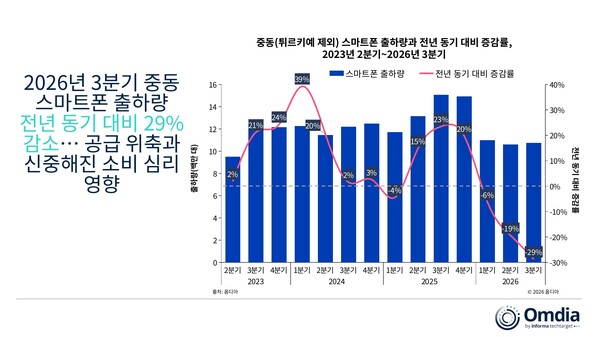
The Middle East smartphone market shrank 29 percent year on year in the third quarter, while Samsung Electronics boosted its market share to 45 percent, the data showed. An analysis said the company held up relatively well on the back of a broad product lineup.
Middle East (excluding Turkey) smartphone shipments in the third quarter of 2026 fell 29 percent from a year earlier to 10.7 million units, market research firm Omdia said on Monday.
Higher component costs, a contraction in the supply of low-end smartphones and weak retail demand were cited as key causes. The market downturn deepened as the off-season summer holiday period, geopolitical uncertainty and distributors' conservative inventory management overlapped.
By country, smartphone shipments in Saudi Arabia and the United Arab Emirates (UAE) fell 29 percent and 12 percent, respectively. They were affected by an extended summer holiday season despite the back-to-school period and national holiday discount events. Shipments in Iraq plunged 58 percent year on year, posting the lowest quarterly level since the first quarter of 2023. Omdia said a weaker currency, political and economic instability, and rising smartphone prices increased the burden on consumers.
The product mix in the smartphone market also changed. Manufacturers are cutting supply of low-priced models and focusing on products with relatively higher profitability.
Shipments of smartphones priced below $200 fell 56 percent year on year, while shipments of models priced at $400 to $599 rose 65 percent. As a result, the Middle East average selling price (ASP) hit a record high of $511.
Manish Prabinkumar, a senior analyst at Omdia, said manufacturers are reducing low-priced models and focusing on higher-margin products as higher component costs have worsened profitability for entry-level smartphones. He said fewer affordable choices are prompting price-sensitive consumers to delay smartphone replacement.
Samsung Electronics expanded its share despite the conditions. Its Middle East smartphone market share rose 11 percentage points to 45 percent in the third quarter this year from 34 percent in the third quarter last year. Solid demand for the Galaxy A17 and Galaxy A07 4G and stable component supply supported the gain.
Xiaomi regained the No. 2 spot, led by the Redmi 17 4G and Redmi A7 Pro 4G. Xiaomi is also pursuing a strategy of reducing the share of entry-level products and focusing on higher-profit models and markets.
Apple's market share rose to 12 percent despite a decline in shipments. Demand for premium smartphones and distribution partnerships supported the share. Supply to distribution channels fell from the year-earlier iPhone 17 series as the base iPhone 18 was excluded from the launch lineup.
Honor posted a double-digit decline in shipments for the first time after three consecutive years of growth. It launched the Honor Choice T10 targeting the under-$150 market but failed to halt the downtrend. Transsion recorded the largest decline in shipments among the top five manufacturers. Its low-end product-focused business structure proved vulnerable to rising component costs.
Omdia expected Middle East smartphone shipments in 2027 to post a single-digit decline. Market conditions are likely to differ by country.
In Saudi Arabia, instalment financing and inventory management are becoming important, and the UAE is expected to maintain a relatively solid trend based on demand for premium smartphones and trade-in programs. Iraq may face a prolonged market adjustment as consumers' replacement cycles lengthen.
Prabinkumar said geopolitical uncertainty and higher component costs have made consumers more cautious about buying smartphones. He said manufacturers and retailers will strictly manage inventories and working capital to protect profitability and focus on selective new product launches.
 Jin-ho Lee
jhlee26@d-today.co.kr
Keyword
#Omdia #Samsung Electronics #Middle East #Saudi Arabia #Apple
