
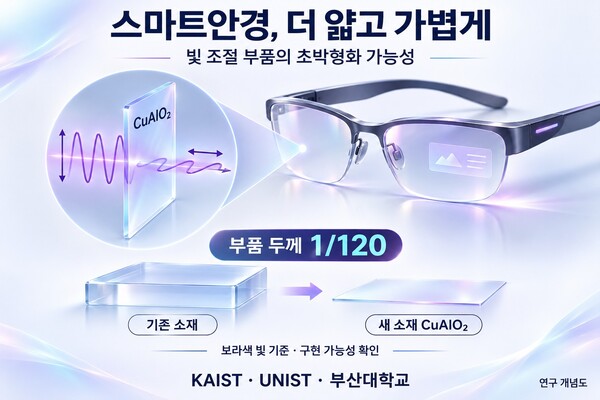
A South Korean research team has found a new material that could reduce the thickness of optical components used in augmented reality (AR) glasses and optical communications equipment to about one-120th of existing levels.
The Korea Advanced Institute of Science and Technology (KAIST) said on Monday that a research team led by Professor Changhee Sohn (손창희) of its physics department, working with researchers from Ulsan National Institute of Science and Technology (UNIST) and Pusan National University, discovered and identified the cause of a property in the oxide semiconductor copper aluminium oxide (CuAlO2) that strongly controls polarisation while allowing light to pass through well.
Polarisation refers to the direction in which light vibrates. Optical communications equipment and displays use components that control such polarisation. A typical component, a half-wave plate, changes polarisation by using birefringence, in which the refractive index varies depending on the direction of vibration of light.
The greater the birefringence, the thinner the same function can be achieved. But crystalline quartz, widely used in existing half-wave plates, has low birefringence, limiting efforts to make components thinner.
The copper aluminium oxide analysed by the research team transmitted visible light well while showing about 120 times higher birefringence than quartz in violet light. The team analysed that this could be used to implement the function of a half-wave plate with a thickness of about 173 nm. That is thinner than half the wavelength of light.
The team confirmed that the property stems from a dumbbell-shaped structure inside the material in which oxygen, copper and oxygen are connected in a straight line. The structure was found to create large differences in optical properties by promoting or suppressing absorption depending on the direction of light vibration.
It also confirmed a "hyperbolic optics" property in the ultraviolet region, in which light propagates differently from general materials. This can be used in the future to develop new ultraviolet optical devices.
KAIST said the research is significant because it found a material that secures both light transmittance and birefringence at the same time.
Sohn said, "We confirmed the possibility that components that transmit light well while controlling the direction of light vibration can be made about one-120th as thick as existing ones." He said it could contribute to making smart glasses and optical communications equipment smaller and lighter.
He added, "We are conducting research to make the material thin and uniform and reduce light loss so it can be used in actual components."
Kang Baek-jun (강백준), a KAIST PhD, and Shin Jun-hee (신준희), a UNIST researcher, participated as co-first authors. The results were published in the international journal Nature Communications on Oct. 13.
 Jin-ho Lee
jhlee26@d-today.co.kr
Keyword
#KAIST #UNIST #CuAlO2 #Nature Communications #AR
