
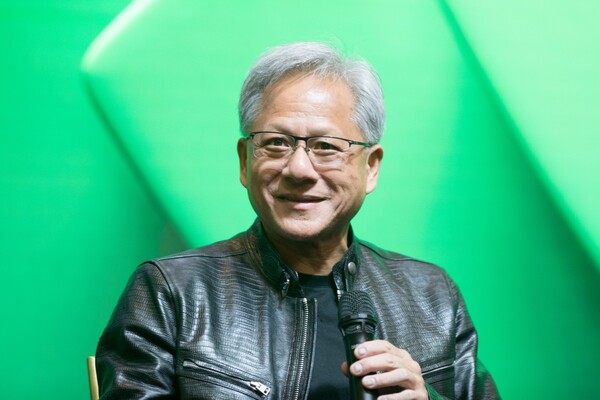
Nvidia's board on Nov. 23, local time, unanimously decided to return Jensen Huang (젠슨 황) as CEO after 11 days.
The White House effectively orchestrated Huang's return. The Information reported that Attorney General Todd Blanche told President Donald Trump over the weekend that there was no evidence to prove illegal acts by Huang, and Vice President JD Vance, acting on Trump's instructions, delivered that message directly to the board.
In an interview with CNBC, Trump did not hide his role, saying, "I persuaded them." Immediately after Huang resigned, Trump recommended Tim Cook, who had recently stepped down from leading Apple, as a successor, but shifted to calling for Huang's return as stocks plunged.
Two main factors drove Huang's return. The first was the impact on stock markets and the AI market.
After Huang resigned, shares of Nvidia and technology-related companies broadly showed a marked decline.
Nvidia has gone beyond supplying chips in the AI arena and has also served as a source of funding. As Huang stepped away, concerns spread that Nvidia would not invest in the AI ecosystem as it had before. That combined with AI bubble fears and weighed on global stock markets. The New York Times reported that when asked whether the stock market influenced the decision to call for Huang's return, Trump said, "Maybe. But the bigger reason is the long-term impact."
Some also see the strategic value of open-source AI models, whose weights are disclosed so anyone can download and modify them, as influencing Huang's return.
The Information reported that Trump and Vance view Huang as a key figure to protect open-source AI and prevent closed-model companies such as Anthropic and OpenAI from becoming too big.
Huang's return does not appear likely to quickly quell the controversies surrounding Nvidia.
First, Nvidia's board can no longer avoid questions about credibility. Harvey Jones, chairman of Nvidia's board, said only last week that the board accepted Huang's resignation because his private life violated the company's code of conduct. A week later, the board put Huang back in the CEO job.
Huang is also embroiled in controversy over an affair with a former executive at a customer that U.S. authorities suspect is linked to a Chinese intelligence agency, as well as with a subordinate employee. An independent investigation led by law firm Wachtell Lipton continues. That raises the possibility of further disclosures.
The New York Times reported that Eric Talley, a professor at Columbia Law School, said, "Reinstating Jensen Huang before the investigation ends could expose the company to shareholder lawsuits and political pressure related to national security."
Corporate governance experts are criticising Trump for sidelining the board. David Yoffie, a professor at Harvard Business School, said, "The board now looks like the president's lackeys," and Jeffrey Sonnenfeld, a professor at Yale School of Management, said, "The entire board should step down."
Moves in Congress are also a variable. The House Intelligence Committee, the House Foreign Affairs Committee and the House select committee on China plan to proceed as scheduled with closed-door testimony from Huang next week, and the Senate Banking Committee will hold a public hearing on Dec. 3. A spokesperson for the House Intelligence Committee said nothing changes because Huang returned.
Axios reported that Republican senators including John Cornyn, John Curtis and Pete Ricketts have also begun questioning what basis Nvidia's board used to conclude there was no national security problem after hearing views from senior officials.
Democrats, who are set to regain control of Congress in January, say they will investigate both allegations of administration intervention and suspected export-control violations. House Democratic Leader Hakeem Jeffries is also calling for strong export-control provisions to be included in the National Defense Authorization Act.
Stocks turned higher after Huang's return, but it remains unclear whether it will fundamentally ease concerns about an AI bubble.
The New York Times reported that at the Federal Reserve's October meeting, almost all of the 19 members mentioned the potential for a shock stemming from disappointment in AI investment. In the Fed's financial stability report released in November, market participants named AI as the biggest threat.
Scott Lincicome, vice president at the Cato Institute, said capital should flow according to business viability, not political patronage. Shiva Rajgopal, a professor at Columbia Business School, put it more bluntly, saying, "There is a growing perception that Nvidia is too big to fail, and Jensen Huang is too important to fire."
 Chi-gyu Hwang
delight@d-today.co.kr
Keyword
#Nvidia #Jensen Huang #Donald Trump #JD Vance #New York Times
