
The display industry’s OLED business focus is shifting to gaming monitors and IT products. A slump in the core market of large OLED TVs has persisted for years, while the smartphone display market is also shrinking. LG Display and Samsung Display are moving to protect profitability with high value-added products instead of new mega-sized investments. Samsung Display appears to be focusing on broadening its product base, while LG Display is emphasizing technological differentiation.
LG Display on Nov. 19 revised its filing to say it has decided not to proceed with investment in a 10.5-generation OLED production facility for ultra-large panel output. When it was decided in July 2019, the investment was valued at 3 trillion won, equivalent to 20.2 percent of its equity. LG Display later extended the investment deadline once, to March 2028, in 2023.
In the latest filing, it decided not to execute the investment. It said the market environment has changed significantly due to external variables such as the pandemic, wars, and high inflation and high interest rates since the initial investment decision. On the demand side, it judged that growth in the OLED TV market has slowed and the shift from LCD to OLED has been slower than expected, leading to years of stagnation in the large OLED market.
Market stagnation is also appearing in the smartphone display market. According to an Omdia forecast cited in Samsung Electronics’ third-quarter report, the smartphone display market is set to fall to 1.23 billion units this year from 1.61 billion units last year. OLED’s share of the overall market is rising, but OLED panel shipments are also expected to decline. The large-display market is also projected to remain at a level similar to last year this year.
The product category the two companies have chosen as a new source of demand is gaming monitors. LG Display said in its filing that ultra-large panels were the mainstay of the large OLED market at the time of its investment decision, but premium products such as gaming OLED monitors are now growing rapidly. It aims to respond to that demand by making the most of its existing large OLED facilities.
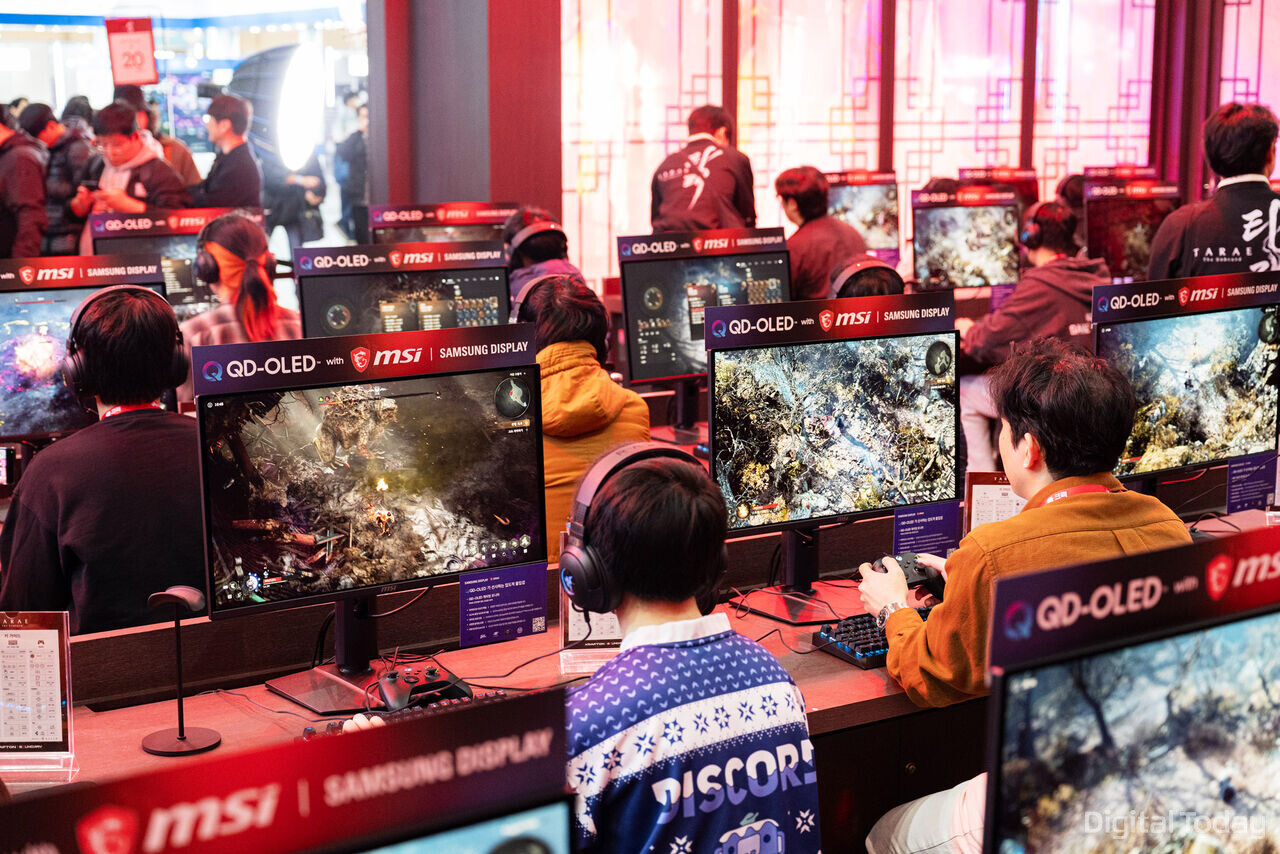
Competition with Samsung Display is also expected. Samsung Display leads the gaming OLED market. Based on Omdia tallies cited by Samsung Display, its share of OLED shipments for monitors rose to 75 percent last year from 65 percent in 2023. Samsung Display also showcased its technology last week by operating QD-OLED experience zones with CD Projekt Red and Krafton at G-STAR 2026 in Busan.
IT products are a new axis for small and mid-sized panels. The OLED market is expected to grow further as applications expand to foldables, IT and automotive uses. Samsung Display plans to preempt the market for OLEDs for tablets and laptops and increase sales through mass production of a new 8.6-generation IT OLED line. It is also rolling out displays for foldables and IT, with a product portfolio spanning from premium to entry-level.
LG Display is highlighting technological competitiveness in its small and mid-sized business. In its third-quarter earnings announcement, it said it would strengthen the competitiveness of high-end products in its small and mid-sized business based on differentiated technology leadership and stable development and production capabilities. It plans to solidify its market position in mobile displays based on technological competitiveness and stable supply capabilities. For IT, it will focus on operating the business around high value-added products and improving cost competitiveness to boost profitability.
Both companies are targeting the same markets, but they are taking different approaches to protect profitability. Samsung Display is seeking to expand its share through broader adoption, while LG Display has chosen a strategy focused on high value-added products through technology differentiation.
Samsung Display is focusing on defending its share by broadening its product base. Its strategy is to expand demand by raising consumer awareness through co-marketing with game companies. Jung Yong-wook (정용욱), a vice president and head of the strategy marketing team at Samsung Display’s large display business division, said it would diversify its product lineup “to mid-to-low priced products” so more consumers can experience QD-OLED monitors.
LG Display is emphasizing technology differentiation. In its third-quarter earnings announcement, it said it would strengthen its gaming OLED lineup using proprietary technology. It also plans to focus on securing technologies that competitors cannot easily follow, such as its recently developed next-generation OLED patterning technology, FLIPP.
 Suk Dae-geon
d2dg@d-today.co.kr
Keyword
#LG Display #Samsung Display #OLED #QD-OLED #Omdia
