
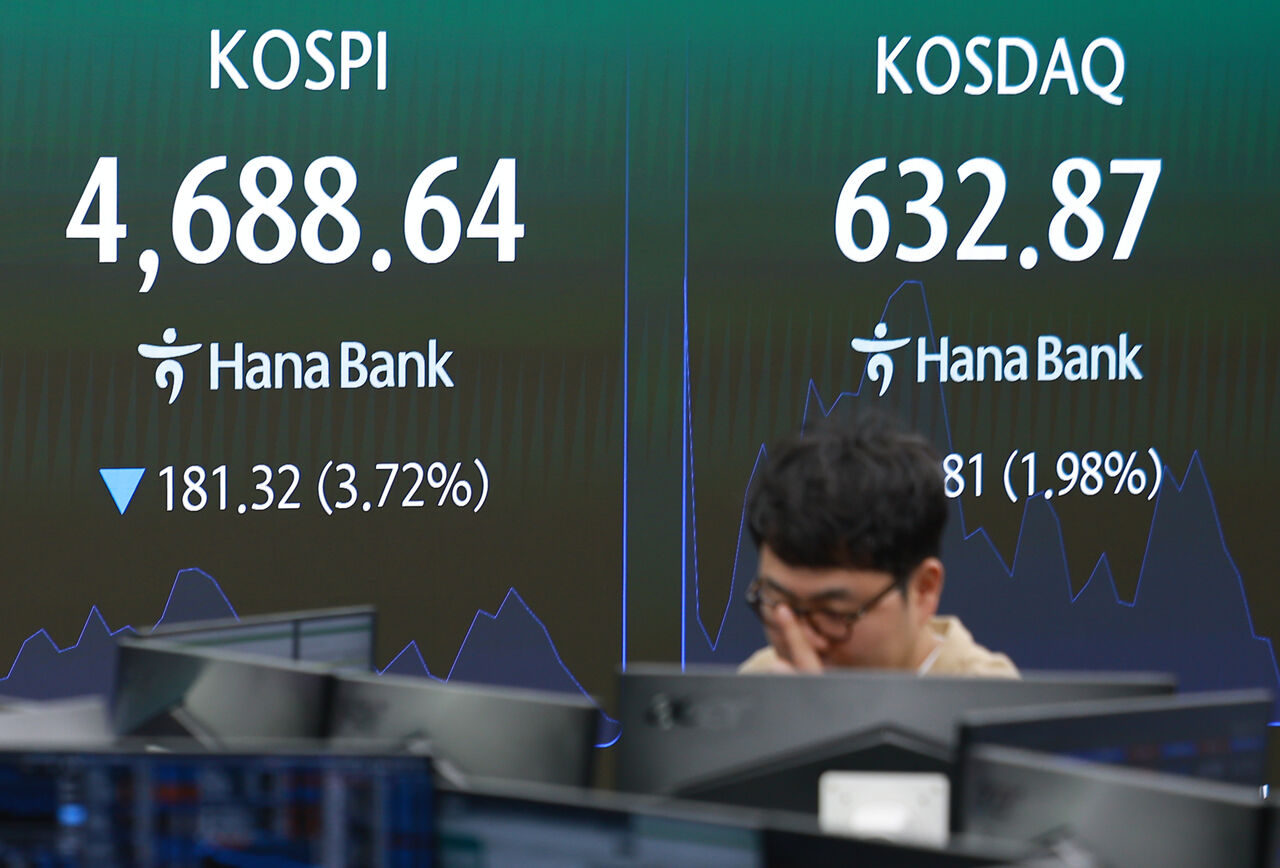
The KOSPI slid to the 4,700 level, but brokers are placing more weight on holding and buying in tranches than on panic selling. The possibility of further corrections remains, but prices and valuations have fallen to levels seen in past crises, analysts said.
On Nov. 23, the KOSPI closed down 161.42 points, or 3.31 percent, at 4,708.54 from the previous session. It fell to the 4,500 level during the session. The Kosdaq ended down 1.58 percent at 635.45.
Samsung Electronics fell 3.06 percent to 177,500 won and SK Hynix dropped 2.52 percent to 1,085,000 won. Foreigners and retail investors each net sold 247.0 billion won and 367.0 billion won worth of KOSPI shares, while institutions net bought 187.2 billion won.
Factors cited behind the recent sharp fall in South Korean stocks include uncertainty surrounding the AI industry, rising global funding demand and worsening foreign investor flows, among others.
Han Ji-young (한지영), a researcher at Kiwoom Securities, analysed that as of Nov. 20 the KOSPI had fallen about 46.6 percent from its peak, marking one of the largest drawdowns on record after the 1997 foreign exchange crisis, the dot-com bubble burst and the global financial crisis.
It took only 4.5 months for the index to fall more than 40 percent from its peak, making the pace faster than the 8.4 months during the dot-com bubble burst and the 11.5 months during the financial crisis.
Doubts about AI companies' profitability have also become a burden as they have spread from a simple debate over lofty valuations to issues of fundraising and financial soundness. In Bank of America's November global fund manager survey, responses that cited an AI bubble and a credit event among AI hyperscalers as the biggest risks totalled 65 percent.
Lee Eun-taek (이은택), a researcher at KB Securities, described the core of the current financial market turmoil as "gravity". He analysed that massive funding needs were absorbing huge amounts of capital through large U.S. Treasury issuance, investment in AI data centres and big initial public offerings, while concerns about tightening by the U.S. Federal Reserve were limiting liquidity supply and pulling markets lower.
Lee said that if the current problem is closer to a liquidity shortage than inflation, there is room for it to be resolved through a Fed policy shift.
He judged that if markets enter a "rabbit hole" phase in which inflation revives, the Fed would find it hard to respond easily, but said the situation has not yet reached that point. He said there is a need to confirm signs of inflation stabilisation after the December Federal Open Market Committee meeting.
For U.S. equities as well, an analysis has emerged that the situation is closer to tightening and a valuation adjustment than to a structural crisis like the financial crisis.
Moon Nam-joong (문남중), a researcher at Daishin Securities, analysed that the S&P 500 fell 3.70 percent and the Nasdaq dropped 5.28 percent on Nov. 20, but the S&P 500's decline since its Oct. 6 peak was 11.6 percent and had not yet reached 20 percent, a common threshold for a bear market.
He judged that the current U.S. stock market is closer to a tightening and valuation adjustment phase than to a situation combining recession with a credit and financial crisis. Moon also cited continued U.S. economic expansion and a continuing uptrend in corporate earnings as grounds.
South Korean stocks also still face the possibility of further declines.
Han analysed that the KOSPI's 12-month forward price-to-earnings ratio has fallen to about 3.4 times, already reflecting a significant deterioration in earnings. He estimated that current prices reflect the possibility that KOSPI net profit could fall by about 47 percent.
Even so, brokers are placing more weight on strategies to hold or buy in tranches in the current range than on the possibility of an additional sharp plunge to that level.
Ha Jang-kwon (하장권), a researcher at Hanwha Investment & Securities, analysed that there is a need to maintain a tranche-buying approach centred on semiconductors around the 5,000 level on the KOSPI. He judged that while short-term supply and demand burdens remain because big growth stock IPOs such as Anthropic could lead global active funds to sell existing holdings, these negatives are already widely known.
Lee Kyung-min (이경민), also a researcher at Daishin Securities, analysed that the KOSPI's prices and valuations have entered a low range comparable to the IMF foreign exchange crisis and the global financial crisis. He suggested a strategy of dividing up capital and approaching the market rather than joining the sell-off.
The pattern after past sharp selloffs is also cited as a reason to be cautious about panic selling.
According to Han, in seven declines since 1990 when the KOSPI fell more than 30 percent from its peak, the average return after the bottom was positive across all periods: 14.9 percent after 20 trading days, 27.6 percent after 60 trading days, 50.9 percent after 120 trading days and 70.5 percent after 200 trading days.
Another variable that could limit downside is the government's move to begin preparations to activate a stock market stabilisation fund. In 2003 and 2008, the KOSPI rose 41.3 percent and 42.0 percent, respectively, over the year after funds were deployed, and in 2020, 2022 and 2024 there were cases in which a short-term bottom formed with only preparations for activation and no actual deployment.
Han analysed, "In the worst scenario, it is necessary to keep the lower bound open down to 4,200 to 4,300 points," but added, "Considering perceptions of record-level oversold conditions in stock prices and the possibility of deploying the stabilisation fund, the likelihood of the worst scenario becoming reality is low."
He also judged that even if further declines occur, they are likely to remain temporary, and said there is a need to review new buying after confirming a bottom while maintaining existing positions.
 Oh Sang-yup
yub@d-today.co.kr
Keyword
#KOSPI #Kosdaq #Samsung Electronics #SK Hynix #Federal Reserve
