
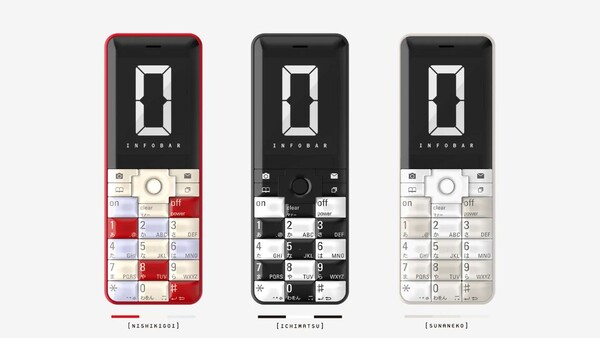
A mobile phone that deliberately excludes internet and social media functions has reappeared. Japan's telecoms company KDDI will launch a new handset called the INFOBAR ZERO, focused on calls and text messages. The product goes in the opposite direction of smartphone convenience and targets consumers seeking a digital detox.
On Nov. 18, IT outlet ITmedia reported that KDDI will release the INFOBAR ZERO on Dec. 25. Pre-orders began at 10 a.m. on the same day. The price is 32,780 yen (about 270,000 won).
The INFOBAR ZERO is designed around voice calls and SMS. It does not support a web browser or social media functions. It has a roughly 2-megapixel camera and basic functions such as a phonebook, calendar, alarm, music playback and calculator. Users must transfer files from a smartphone or PC to listen to music.
The product is the latest model in the INFOBAR series, first released in 2003. It is the first new product in about 8 years since the INFOBAR xv in 2018, and its keypad applies acrylic tile keys again for the first time in 23 years since the initial model.
KDDI sees a trend of deliberately reducing use of digital devices spreading, particularly among younger people. It introduced a scaled-down handset known as a “dumbphone,” which drew attention in Europe and the United States, adapted for the Japanese market.
At a launch event, Satoshi Sunahara (스나하라 사토시), an official in KDDI's brand management division, said, "If smartphones are the reinvention of the telephone, INFOBAR could be the re-reinvention of the telephone." He said it means not only reducing functions but also newly proposing how people use communications devices after smartphones.
Whether it can secure real demand remains uncertain. In Japan, messenger app LINE is widely used, and some have pointed out that younger people may not be accustomed to sharing phone numbers. Questions were also raised about whether the digital detox effect could be limited if users have to carry a smartphone separately.
Sunahara also acknowledged that he mainly uses LINE rather than voice calls or SMS. He explained that brief communication centered on calls and texts could be a new experience. He also mentioned the possibility that exchanging short messages could be accepted like Japan's traditional poetry, such as haiku or tanka.
Naoto Fukasawa (후카사와 나오토), the product designer in charge of the design, focused on the point that users do not have many people to call. He said, "There could also be a way like an old transceiver, putting it in a pocket and connecting with specific people." He outlined using it as a secondary device that focuses on communication with a few people rather than an all-purpose device connected to many.
The INFOBAR ZERO also supports a “second number” service that adds an extra number dedicated to calls and SMS. Users can use a separate number from their smartphone on the INFOBAR ZERO. As the first in-house model under KDDI's official SIM-free brand, au Flex Style, it can be used on carrier lines other than au.
Development began from internal moves to make a phone with minimal functions, rather than from reviving the INFOBAR series itself. The price was set lower than the previous model. Sunahara explained that despite rising component prices such as memory, the company procured parts from the early stage of development and set a price cheaper than the INFOBAR xv at 51,840 yen (about 430,000 won).
KDDI did not disclose specific sales targets. Sunahara said he expects a level that is in the single digits lower than past sales volumes. The company plans to decide whether to continue the series after gauging market reaction and ripple effects rather than pursuing large-scale sales.
 Seung-a Yoo
ysah@d-today.co.kr
Keyword
#KDDI #INFOBAR ZERO #SMS #LINE #au Flex Style
