An analysis said expanded investment in artificial intelligence must be matched by lower deployment costs and services tailored to industry demand for the 5G private network market to grow. It also raised the need to improve spectrum rules to meet new demand such as mobile communications networks.
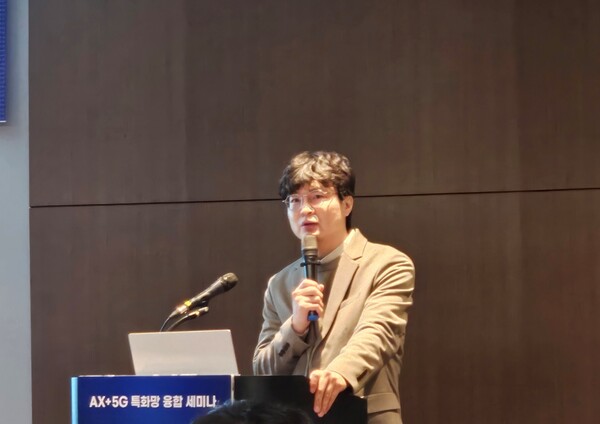
An 'AX+5G private network convergence seminar' was held at the radio industry conference during '2026 Radio Broadcasting Industry Promotion Week' at COEX in Seoul on Tuesday. The seminar, hosted by the Korea Communications Agency (KCA), discussed the role of 5G private networks and ways to energise the market as physical AI spreads.
A 5G private network differs from a commercial 5G network in that a company or institution builds and operates a dedicated network in a specific area or facility to meet its own communications needs. It is mainly used in factories, logistics centres and ports, where stable connections and low latency are important. The government is also supporting the spread of private networks. The Ministry of Science and ICT and KCA are promoting this year’s "next-generation private network convergence service expansion project" to support private network deployment at industrial sites and demonstrations of converged services.
◆ AX growth alone may not expand the private network market; costs and economics are challenges
Dong-ju Lee (이동주), CEO of HyperX, addressed opportunities and challenges for the private network market as industrial AI transformation, or AX, spreads, under the theme "Now is the AX era: asking the path 5G private networks must take."
Lee said, "Even if the AX market grows, the private network market does not grow in the same way," adding, "A market forms only when private networks are actually chosen." He said private networks must prove their competitiveness because alternatives exist such as wired networks, Wi-Fi and commercial mobile networks even as AI adoption expands at industrial sites.
The cost of building a 5G private network was also cited as an obstacle to market expansion. A manufacturing AX leading model presented by HyperX said introducing data infrastructure, AI models, robots and automation equipment would cost more than 3 billion won even excluding the communications network.
With significant investment required to build industrial AX, adding the cost of adopting a private network could increase the burden on companies. In a manufacturing private network demand survey conducted by HyperX in 2024, more than half of respondent companies selected less than 50 million won as the amount they could spend for initial adoption.
Lee said, "There may be a gap between the deployment cost that private network suppliers have in mind and the cost that demand companies are willing to bear," adding, "We need to create a price structure that demand companies can adopt."
Securing price transparency was also raised as a task. He said a system is needed to compare common quotation items and total cost of ownership (TCO), as it is difficult to easily compare equipment prices, software fees and maintenance costs.
Lee also argued that the evaluation method for government support projects should be improved. If existing demonstration projects focused on network deployment and performance verification, future evaluations should also look at productivity gains, cost reductions and the possibility of follow-on investment, he said. "It is important to check whether it is a service that can be voluntarily adopted and operated in the field even after a government project ends," he said, adding, "It must prove real investment value."
◆ Communications network role rises as physical AI spreads; spectrum rules need improvement
Lee also pointed to changes in the communications environment as physical AI spreads. In a conventional factory, a manager would check a control screen and take action when equipment abnormalities occur. In an AX environment, AI can determine abnormalities, change the work sequence, or directly instruct robots and equipment to perform tasks. The role of 5G private networks grows in this process. Stable connections and low latency are needed when multiple robots move while exchanging information or carrying out instructions from a central system.
He said continuity of connections and communications quality management become more important in an environment where dozens of robots exchange data. By contrast, fixed inspection equipment may be suited to wired networks, and typical indoor data collection may be sufficient with Wi-Fi. He said private networks must find their own competitiveness.
A call was also made to increase flexibility in the spectrum system. In South Korea, the 4.7 GHz and 28 GHz bands are currently used for 5G private networks. Spectrum is supplied based on pre-designated areas such as buildings or land.
As the use of physical AI expands to agriculture, construction and ports, the installation location and operation method of communications networks may also change. Construction sites may need to move base stations as work progresses, and disaster sites may generate demand to use networks only for a short period. Lee suggested reviewing spectrum system flexibility so private networks can be used along movement routes, across wide areas, and in spaces with different heights and depths.
◆ AI-RAN and integrated communications and sensing draw attention; private network use seen widening
Hyo-chan Han (한효찬), executive director at Nokia Korea, who presented after Lee, said the role of communications networks is expanding beyond data transmission to computing and sensing the surrounding environment as physical AI spreads. He pointed to AI-based radio access networks (AI-RAN) and integrated sensing and communications (ISAC) as key technologies to implement this.
AI-RAN combines GPU-based computing functions into base stations to carry out network operations and AI computing together. ISAC uses communications radio waves to sense the location and movement of surrounding objects, and can be used for controlling robots and drones.
Han introduced a case in Finland where Nokia used a 5G network to detect the approach of drones. It senses surrounding objects using communications radio waves and antennas, and could be used in the future for intrusion surveillance at defence facilities and for monitoring moving objects at ports and logistics facilities, he said.
He forecast that these technologies could be applied first to 5G private networks tailored to specific industries such as defence and transport and logistics, rather than general commercial mobile networks. Han said, "Requirements for private networks are increasing more and more," adding, "I think the first use case of 6G will be private networks."
 Jin-ho Lee
jhlee26@d-today.co.kr
Keyword
#5G #Ministry of Science and ICT #KCA #Nokia #AI-RAN