
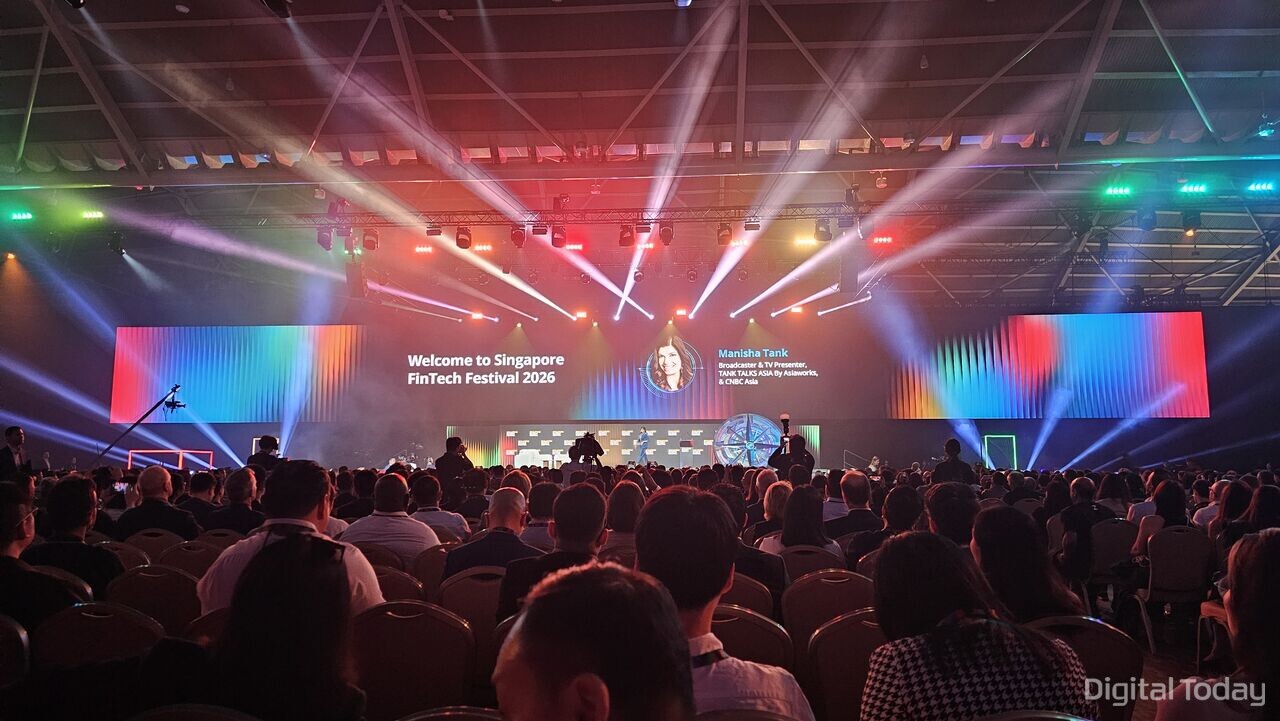
[Singapore = DigitalToday reporter Ji-young Lee] The Singapore FinTech Festival (SFF) 2026 opened on Nov. 18 at Singapore Expo to examine the global financial industry’s digital transformation and the direction of AI innovation. This year, key agenda items included AI-based responses to financial crime, innovation in corporate finance and payments based on AI agents, highlighting broader changes across the financial industry.
Singapore’s government in particular set out a direction to develop AI technology into shared infrastructure for the financial industry, beyond using it to improve efficiency within individual financial companies, by unveiling three national AI missions for financial services.
At the opening event, speakers including Ravi Menon (라비 메논), chairman of the board of the Global Finance and Technology Network (GFTN), Michael Spence (마이클 스펜스), a professor at Stanford University, and Gan Kim Yong (간 킴 용), Singapore’s deputy prime minister and chairman of the Monetary Authority of Singapore (MAS), discussed how AI could affect the financial industry and the global economic order.
Singapore announces three national AI missions for the financial sector
In a keynote speech, Deputy Prime Minister Gan Kim Yong presented three national missions to accelerate the AI transition in financial services: stronger prevention of financial crime, improved access to corporate financing, and support for safe transactions by AI agents.
“AI is reshaping the nature of competition, including in financial services,” Gan said. He said the ways companies assess risk, allocate capital and provide services to customers are changing.
He stressed that Singapore’s financial industry must quickly apply new technologies to real businesses to remain competitive. Gan said establishing clear standards and effective safeguards is essential to earn the trust of financial companies and consumers.
The first mission is to strengthen systems to detect and prevent financial crime using AI. Gan said it is difficult to effectively block crime if individual financial companies only analyze transactions on their own, as funds from fraud victims can move through multiple institutions in a short time.
Singapore plans to build a joint response system that securely links information among financial companies and uses AI to identify suspicious transactions early.
A pilot project involving 5 banks is under way in Singapore. It is testing whether an AI model can detect fraud patterns that are difficult for individual banks to identify by combining transaction data from banks in a secure way.
MAS plans to launch research early next year to design operating and governance frameworks for a shared fraud-detection infrastructure for the financial sector, based on the pilot.
The second mission is to improve access to funding for small and medium-sized companies and startups. There are concerns that corporate credit evaluations by existing financial institutions rely heavily on past performance, repayment history and collateral, making it difficult to fully reflect the growth potential of companies with short operating histories or limited assets.
Singapore’s government is pursuing ways to use AI to analyze bank accounts and invoices, payment histories, corporate information and data held by public institutions to assess corporate credit more precisely.
The plan is to increase the accuracy and efficiency of loan screening and expand access to finance for small and medium-sized companies.
The third mission presented is to create a safe transaction environment so AI agents can participate in financial transactions.
Ravi Menon says interoperability of international payment networks is important in the AI era
In an earlier keynote speech, GFTN board chairman Menon assessed that the spread of AI technology could deepen geopolitical competition in global supply chains and the technology and financial sectors, while also providing new opportunities for cooperation.
He pointed in particular to moves by countries to build alternative payment networks to reduce reliance on existing international financial systems.
As a representative example of efforts to increase interoperability among international payment networks, Menon introduced Project Nexus.
Project Nexus aims to improve the efficiency of cross-border transfers by linking national real-time payment systems. Its goal is to reduce complex intermediary procedures by connecting countries’ payment systems through a common network.
Menon said competitiveness could further increase for payment networks that are low-cost and open if AI agents choose payment routes on behalf of users.
“AI agents can handle currency conversion, message formats and compliance procedures between different payment systems,” he said.
Menon stressed the need to establish common standards on identity verification and transaction authorisation so AI agents can transact safely across borders.
He also mentioned employment issues that could arise during the spread of AI. Menon said consideration for jobs and wages is needed for AI technology to be widely accepted socially. He said it is necessary to examine both the potential for job replacement due to automation and wage increases resulting from higher productivity.
Michael Spence says broad diffusion across industries is key to AI productivity gains
Spence, who held a dialogue with Menon, stressed that to turn advances in AI technology into actual economic growth and productivity gains, diffusion of the technology across industries is important.
He said it is necessary to distinguish between developing cutting-edge AI models and using AI in actual industrial settings. While large investments are concentrated on AI development, applying the technology to corporate operations is still at an early stage, he said.
He said if the use of AI remains limited to certain areas such as software development or finance and does not expand to major employment sectors such as government, healthcare, education, distribution and service industries, the productivity improvement effect for the overall economy could be limited.
On AI’s impact on jobs, Spence forecast that collaboration between humans and AI would be a major form, rather than simple replacement of human labour.
He stressed that companies should consider how they develop new talent, as tasks for young people are changing due to AI adoption particularly in finance and professional services.
Spence said it would take considerable time for AI’s productivity effects to materialise in earnest. He said corporate work practices, workforce operations and policy support must change along with diffusion of the technology.
Competition in financial innovation extends to exhibition hall; Hecto Group targets global markets
Changes in the financial industry presented in the keynote speeches were translated into concrete technologies and services on the exhibition floor. As global finance and fintech companies showcased next-generation payment technologies and digital financial services, South Korean companies also moved to target overseas markets.
Hecto Group will operate a group-wide integrated booth at the event, moving away from its previous participation centered on Hecto Financial and combining technologies and services from key affiliates.
Under the theme “THE HECTO ORBIT: Daily life connected by technology,” it is presenting a business ecosystem linking areas from digital-asset wallets to global remittances, payments and settlements, data, e-commerce and healthcare. It is a strategy emphasising group-level technical linkage and business scalability.
For visitors, it prepared an experience programme in which they access an event-only digital-asset wallet through a QR code and exchange drinks and other items using coins they receive. The plan is to help visitors directly experience how digital assets connect to real-life benefits, increase understanding of the wallet service and lead to future use of the full service.
For corporate clients, it is introducing Hecto Financial’s global remittance and payment and settlement services based on the Circle Payments Network (CPN), Hecto Innovation’s corporate wallet infrastructure, and Hecto Data’s global know-your-customer (KYC) and e-commerce solutions.
Hecto Group plans to use the exhibition as a chance to identify potential customers including overseas financial institutions and fintech and e-commerce companies, and to expand global partnerships through business linkages among its affiliates.
At the SFF opening event, a common topic was that AI could affect not only competitiveness in the financial industry but also the international payment system, the job market and financial consumer protection. As Singapore publicly set out the direction for building shared AI infrastructure for the financial sector, discussions are expected to continue in the global financial industry over actual adoption and safe use of AI technology.
 Ji-young Lee
ljy@d-today.co.kr
Keyword
#Singapore FinTech Festival #Monetary Authority of Singapore #Project Nexus #Global Finance and Technology Network #Hecto Group
