
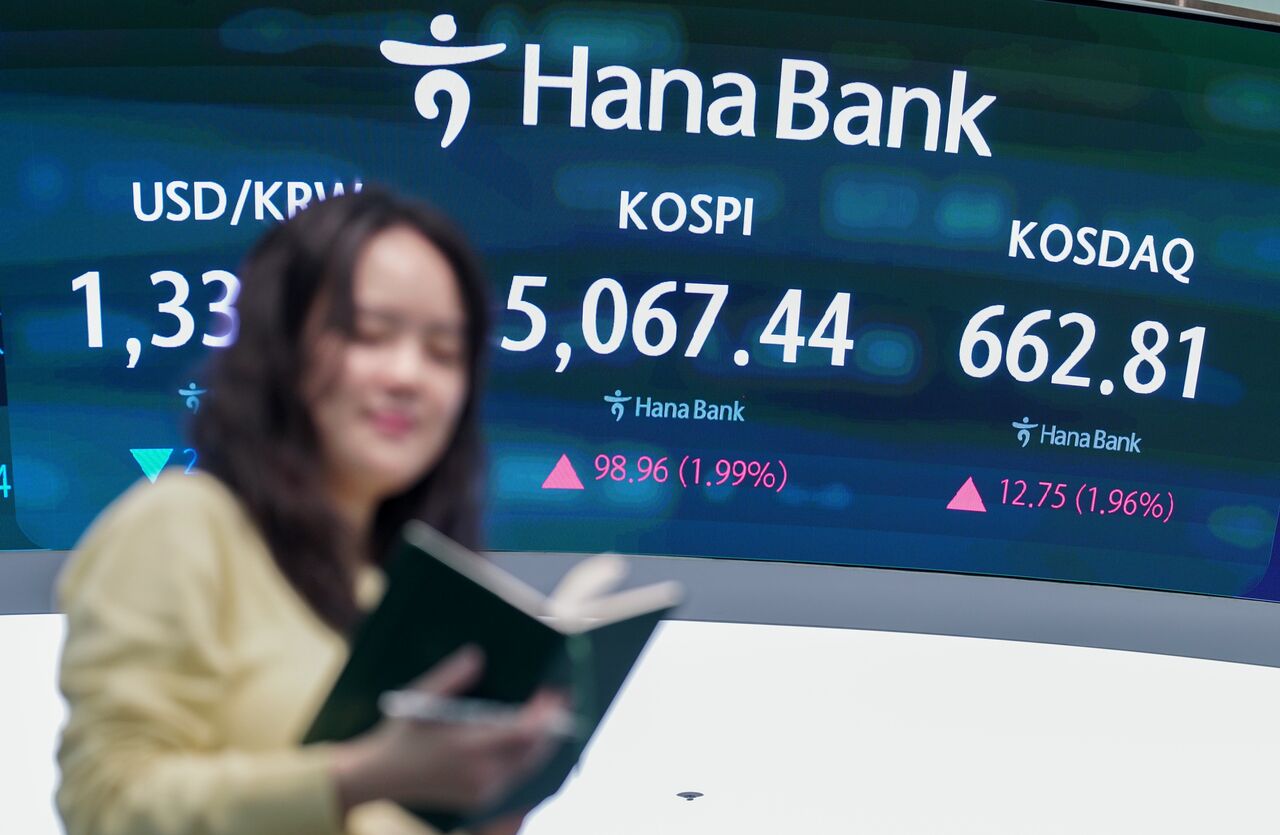
South Korean stocks rebounded on Nvidia's strong results and institutional buying. The KOSPI, which had fallen below the 5,000 level a day earlier, regained it in one session. Semiconductor stocks including Samsung Electronics and SK Hynix also rose across the board.
On Nov. 18, the KOSPI ended up 98.96 points, or 1.99 percent, at 5,067.44. The index opened up 130.34 points, or 2.62 percent, at 5,098.82 and swung between gains and losses before closing in the 5,060 range.
By investor type, institutions were net buyers of 511.2 billion won. Retail investors were net sellers of 637.7 billion won and foreign investors net sold 333.8 billion won.
Nvidia's third-quarter results influenced the rebound on the day.
Nvidia announced on Nov. 17 local time that revenue for the third quarter of fiscal 2027 rose 103 percent from a year earlier to $115.8 billion. It also increased 20 percent from the previous quarter and exceeded the company’s earlier forecast of about $108.0 billion.
With concerns lingering over a slowdown in AI investment, Nvidia confirmed strong revenue growth and data centre demand, drawing buying into South Korean semiconductor stocks as well.
Samsung Electronics closed up 2.31 percent at 194,700 won, while SK Hynix rose 4.19 percent to 1,144,000 won.
Samsung Electro-Mechanics gained 7.43 percent, SK Square rose 4.42 percent, Hyundai Motor advanced 3.09 percent and Samsung Life climbed 5.37 percent.
Samsung Biologics fell 3.39 percent, while KB Financial Group and LG Energy Solution slipped 0.26 percent and 0.16 percent, respectively.
The Kosdaq ended up 12.75 points, or 1.96 percent, at 662.81.
After extending gains early in the session, it turned lower briefly in the morning but later rebounded and finished higher.
In Seoul's foreign exchange market, the won stood at 1,333.00 per dollar, up 2.50 won from the previous session.
Han Ji-young (한지영), a researcher at Kiwoom Securities, analysed that South Korean stocks started to rebound on the back of U.S. semiconductor stocks paring late-session declines and semiconductor companies reporting strong results.
Han explained, "The previous day, the KOSPI closed below 5,000 points, breaking below the early-November low, and it fell below 5,000 points for the first time since Feb. 2. With buying forces absent, this is raising the market’s response difficulty."
She added, "What is needed now is not further upgrades to profit forecasts but regaining confidence in profits that have risen so far," and said, "This is a matter of time, but also an issue that must be resolved in the short term."
 Oh Sang-yup
yub@d-today.co.kr
Keyword
#KOSPI #Nvidia #Samsung Electronics #SK Hynix #Kosdaq
