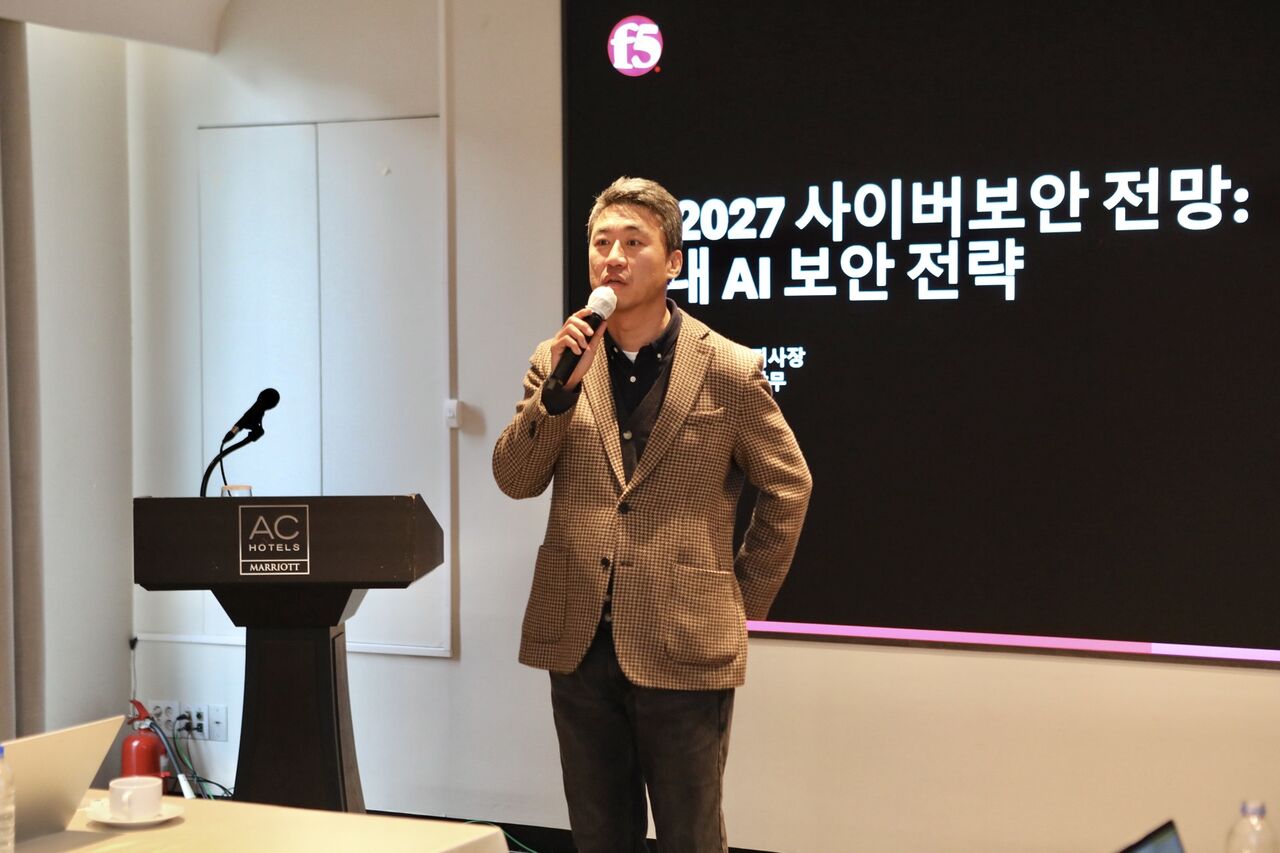
F5, an application and API delivery and security company, held a media briefing on Tuesday titled “F5 2027 Cybersecurity Outlook” and presented major cyber security projections for 2027 and its strategy.
At the briefing, F5 named three key shifts: securing data sovereignty driven by the spread of sovereign AI, adopting multimodel AI to ensure operational stability, and accelerating AI-based cyberattacks.
On securing data sovereignty, Jin-won Lee (이진원), an executive director at F5 Korea, said that as investment in AI infrastructure expands by country and regulatory demands for data protection rise, companies must consider not only where data is stored but also the environment in which security policies are actually applied and audited. He said responding to these changes requires placing security functions closer to users and AI workloads to minimise delays in AI service responses and applying consistent security policies even in distributed environments.
On adopting multimodel AI to ensure operational stability, it stressed that as connections between AI models and agents become more complex, a service outage or access restriction by a specific model provider could affect corporate operations. It emphasised that companies need to reduce dependence on a single AI model and build a model-independent architecture that can flexibly switch models as needed.
On accelerating cyberattacks as AI models advance, it said that relying only on applying software patches after vulnerabilities are disclosed makes it difficult to respond to rapid attacks. It said shifting to an edge-centred security system using AI and automation and applying virtual patching at the network edge until actual software patching is completed is becoming an important strategy to block attacks.
Hyung-wook Lee (이형욱), the country head, also introduced F5’s latest survey results targeting corporate executives in the Asia-Pacific region. The survey found that 63 percent of respondents cited unpredictable AI and token costs as an obstacle to expanding AI use, while 53 percent said they do not allow sensitive information to be transferred overseas.
It said 50 percent assessed existing security solutions as lacking AI response capabilities, and 35 percent were concerned about data leaks caused by autonomous AI agents. F5 introduced its cooperation with Indonesian telecom operator Indosat Ooredoo Hutchison as a case responding to these challenges. F5 explained that the Indosat Intelligence Suite launched by the two companies is based on F5’s integrated security architecture and supports access to more than 300 AI models, and is designed to allow companies to flexibly switch models and manage costs while maintaining data sovereignty.
F5 said it strengthened support for application and AI security for South Korean companies after launching a new point of presence, or PoP, for its F5 Distributed Cloud Services in South Korea in September and signing a strategic partnership with SK Telecom.
The company said the new PoP in South Korea enables it to provide application delivery and security functions closer to domestic customers and users, reducing latency and supporting consistent security across cloud, on-premise and edge environments.
SK Telecom is the first domestic managed service provider, or MSP, partner for F5 Distributed Cloud Services, and the two companies agreed to strengthen security capabilities for South Korean companies based on a web application firewall, API security, defence against DDoS attacks and bot attacks, and to provide an integrated managed service spanning deployment as well as operations and security.
Lee said companies are deepening their concerns about costs, data sovereignty and security as they expand AI from a trial stage into actual business operations. He said F5 will support South Korean companies in responding to new challenges arising from AI adoption and building a safe and efficient AI operating environment based on an integrated platform covering application delivery and security.
F5 also introduced at the briefing its integrated AI security platform strategy to respond to changes in the security environment. The F5 AI Security Platform supports security management across companies’ overall AI use and operations by integrating functions such as AI security posture management, AI guardrails, automated security testing, AI traffic monitoring and a model gateway.
F5 said it will continue to support South Korean companies in securing security, performance and operational stability in a rapidly changing AI environment based on its integrated platform covering application delivery and security.
 Chi-gyu Hwang
delight@d-today.co.kr
Keyword
#F5 #SK Telecom #Indosat Ooredoo Hutchison #Distributed Cloud Services #Indosat Intelligence Suite