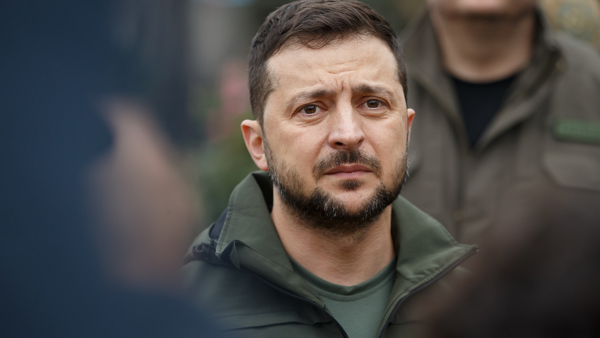
Ukraine says speed limits applied to U.S. SpaceX's satellite communications service Starshield in Russian-occupied territory remain in place, and it is continuing talks with the U.S. side. President Volodymyr Zelenskyy (Volodymyr Zelenskyy) said on Nov. 17 local time on X, formerly Twitter, that the restrictions were undermining Ukraine's defensive capabilities.
Zelenskyy said, "The speed limit on Starshield in the temporarily occupied territories remains in place," adding, "We are discussing this with the American side."
Zelenskyy also said last week that Ukraine was investigating indications that new restrictions had been applied to Starshield on the Ukrainian front and in Russian-occupied territory. He claimed at the time that in some cases Ukraine had already failed to block certain attacks because interceptor systems could not reach sufficient speed and did not respond in time.
The speed limits in question cut Starshield internet connectivity for Ukrainian drones flying at about 100 miles per hour, or about 161 km per hour, or faster. Drones that lose the connection can, in some cases, crash. Ukraine uses interceptor drones to respond to Russian drone and missile attacks. It said that with air defence missile stocks in short supply, the communications restrictions were adding to the burden on defensive operations.
The controversy emerged as U.S. President Donald Trump, Russian President Vladimir Putin and Chinese President Xi Jinping are set to hold a three-way meeting on the sidelines of an Asia-Pacific Economic Cooperation (APEC) summit in Shenzhen, China, on Nov. 19. Elon Musk, SpaceX's chief executive officer, is also expected to accompany Trump on his trip to China. SpaceX did not immediately respond to a request for comment.
The Starshield speed-limit controversy is not the first. Ukrainian authorities said in late October that similar restrictions were applied to a military network. Trump and Musk denied claims at the time that they had ordered the slowdown.
Musk said the Starshield system is "owned by the U.S. government and controlled by the government," and that speed and usage restrictions are "decided by the U.S. military and ultimately decided by the U.S. president." By contrast, the Wall Street Journal reported, citing U.S. officials and people familiar with the matter, that Musk ordered the slowdown.
Canada is also watching the issue. Canadian Defence Minister David McGuinty (David McGuinty) said on Nov. 18, ahead of a NATO Ukraine defence contact group meeting, that he was confident Canadian Prime Minister Mark Carney (Mark Carney) would raise the Starshield restrictions issue with Trump.
Somewhere around two years ago, there was a lot of talk in America about peace through strength. We hardly hear that anymore. But it is still relevant. Peace comes to those who know how to defend life and do so more effectively than those who seek to destroy it. If Russia continues to bet so heavily on ballistic missiles, including those from North Korea, it would be fair for our partners to help us balance the scales in defending lives. This means missiles that Europe has and that can strike Russian weapons production facilities with great precision, as well as American technologies that could enable us to strike Russia’s ballistic missile launchers. A Russia without them is a Russia with a reason to end the war as soon as possible. America can help make that happen. Everyone knows what is needed to achieve this. Everyone understands that it could be effective. But instead of giving us the right to defend ourselves in this way – instead of opening up satellite communications to strike Russian and North Korean ballistic missile launchers near our borders – we see the opposite. The speed limit on Starshield in the temporarily occupied territories remains in place. We are discussing this with the American side.
 Seung-a Yoo
ysah@d-today.co.kr
Keyword
#Starshield #SpaceX #Volodymyr Zelenskyy #APEC #NATO