
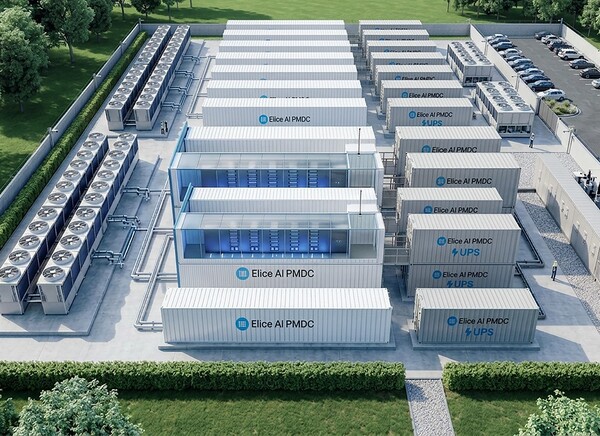
South Korean neocloud company Elice has recorded an operating profit margin that far exceeds overseas competitors. An analysis pointed to demand-tailored investment, rapid deployment and high GPU utilisation that helped secure revenue early to offset fixed costs such as depreciation.
In the third quarter, Elice posted consolidated revenue of 20.8 billion won and operating profit of 6.2 billion won. Its operating margin was 29.8 percent, keeping a similar level to the first half of the year, when it was 30.1 percent.
By contrast, U.S. neocloud company CoreWeave reported third-quarter revenue of $3.661 billion and operating profit of $207 million, for an operating margin of 5.7 percent. Nebius also posted revenue of $980.8 million and operating profit of $50.4 million, leaving its operating margin at 5.1 percent.
An interesting point is that overseas neocloud companies also showed high profitability before depreciation. CoreWeave's third-quarter adjusted EBITDA margin was 62 percent, and Nebius' AI cloud segment was 53.2 percent. Elice's first-half EBITDA margin was 67.5 percent. Fixed cost burdens such as depreciation were seen as a key factor behind the gap in operating margins.
CoreWeave's third-quarter depreciation and amortisation expenses were $1.889 billion, accounting for 51.6 percent of revenue. Revenue rose about 168 percent from a year earlier, but depreciation increased about 200 percent.
This is linked to an aggressive infrastructure expansion strategy. Because the business requires massive investment in GPUs and data centres, depreciation and operating costs also accumulate as new facilities come online one after another. Profitability faces greater pressure if a company keeps expanding new facilities before securing sufficient revenue and profit from existing ones.
CoreWeave had an order backlog of $132.5 billion as of the end of the third quarter. Contracted power capacity exceeded 4.6 GW, but capacity actually in operation was around 1.7 GW.
Elice, by contrast, has emphasised a method of building only the scale of infrastructure needed after confirming customer demand. It expands capacity in stages while securing sufficient revenue from invested facilities.
Elice's self-developed modular AI data centre, called the 'AI PMDC', can be built in about 3 months, compared with the 24 to 36 months typically required to build a conventional data centre. When customer demand emerges, it can quickly secure facilities and supply services, reducing the time it takes for revenue to start.
Directly building and operating data centres is also a factor in reducing costs. Elice said it reduced operating expenses and the cost of foreign licences by building its own infrastructure instead of leasing external data centres and by bringing cloud software in-house. The power usage effectiveness (PUE) of Elice's existing facilities is 1.2, lower than Nebius' 1.25 and close to global cloud companies such as Amazon Web Services at 1.14 and Google at 1.09. It is designing new facilities with a target of 1.1.
After deployment, it focuses on maximising GPU utilisation. It said its proprietary cloud infrastructure software, 'ECI', accepts various types of demand such as long-term reservations, on-demand and spot instances to minimise GPU idle time. Elice said GPU utilisation is close to 100 percent and revenue utilisation remains above 90 percent.
Elice Group CEO Jaewon Kim (김재원) said, "We decide whether to invest by comprehensively considering customer demand, financing costs and supply availability." He said, "The principle is not to build infrastructure excessively if demand is not secured."
Elice's operating margin fell to 13.1 percent in 2025 from 40.9 percent in 2023, but rebounded to 30.1 percent in the first half of this year as revenue rose sharply. The company said the distribution of fixed cost burdens as revenue expanded was a factor behind the profitability improvement.
Still, the key issue is how profitability changes with large-scale infrastructure investment going forward. Elice decided in October on a new facilities investment of 330 billion won to build an AI PMDC and GPU infrastructure in the Honam region.
How quickly revenue generated from the new facilities offsets rising costs such as depreciation is expected to determine future profitability.
An Elice Group official said, "We plan to proceed with new infrastructure investment in stages as well, based on customer demand and long-term usage contracts." The official added, "Through the modular data centre's fast deployment and high GPU revenue utilisation, we will bring forward the point when new facilities start generating revenue, manage the burden of fixed costs such as depreciation, and maintain profitability."
 Seulgi Son
sageson@d-today.co.kr