
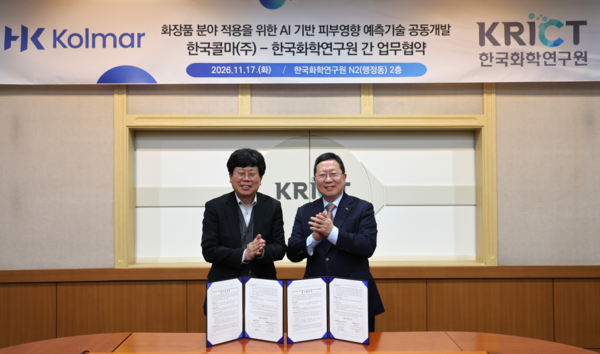
[DigitalToday reporter Jin-ho Lee] The Korea Research Institute of Chemical Technology will develop technology with Kolmar Korea that uses AI to predict in advance how cosmetic ingredients and products affect the skin.
The institute said on Nov. 18 it signed a business agreement with Kolmar Korea on Nov. 17 at its Daejeon campus to jointly develop AI-based skin impact prediction technology for application in cosmetics.
Under the agreement, the two organisations will pursue joint research and technology exchanges on AI-based skin impact prediction technology. They will also review the validity of the prediction technology and demonstrate and verify prediction models using cosmetic ingredients and formulations (mixtures).
The institute will develop a cosmetics-focused skin impact prediction model using its AI-based toxicity prediction technology for single substances and mixtures. Kolmar Korea will provide actual ingredient and formulation information based on its experience developing cosmetic ingredients and products, and will verify the technology's potential for industrial application.
The institute's AI-based toxicity prediction technology can be applied not only to consumer chemical products and biocidal products such as disinfectants and mould removers, but also to cosmetics.
Earlier, the two organisations reviewed the technology's applicability by analysing ingredients of a lip mask product provided by Kolmar Korea and in-house developed natural substance-based ingredients using a skin sensitisation prediction model. Based on that work, they will seek ways to improve the prediction model's accuracy and usability.
The two organisations expect the joint research will make it possible to predict skin effects of cosmetic ingredients and mixtures at the development stage. They also expect it can later be used for product design and research and development that take safety into account.
KRICT President Seok-min Shin (신석민) said, "This agreement will serve as an opportunity to apply the AI-based toxicity prediction technology that KRICT has accumulated to actual cosmetics research and development." He added, "We will continue to ensure that AI core technologies in the chemical field can contribute to safety in people's daily lives and improvements in quality of life."
Byeong-seok Moon (문병석), head of the Technology Research Institute at Kolmar Holdings, said, "We expect that combining Kolmar Korea's experience in cosmetics research and development with KRICT's AI-based prediction technology will further strengthen our capabilities in safety evaluation of cosmetic ingredients and products."
 Jin-ho Lee
jhlee26@d-today.co.kr