
OpenAI unveiled two new artificial intelligence models, GPT-6.2 Astra and GPT-6.2 Sol, each specialized for complex professional work and everyday tasks, respectively. The two models focus on improving task accuracy and token efficiency to handle complex work at lower cost.
On Nov. 17, OpenAI said the two models would be available from that day on ChatGPT Work and Codex to users on Plus, Pro, Enterprise and Edu plans. Developers can also use them through the OpenAI API. They are not available to free accounts and can be used in the Work environment rather than general chat mode.
GPT-6.2 Astra is designed for professional projects such as financial analysis, legal research, presentation creation and complex coding. When given a screenshot of an existing presentation, it can produce new slides reflecting layout, colors and even font sizes. Its ability to revise and test existing code projects has also improved. Early testers said code structure became cleaner, tests became more specific and revision work decreased.
GPT-6.2 Sol is an efficient model for everyday coding, document writing and multi-step tasks. In Cognition's FrontierCode 2.0 evaluation, the score gap between Astra and Sol was only 0.5 points when both models were run at maximum reasoning performance. Sol's per-task cost was about one-fifth of Astra's.
Performance results varied by test. In OpenAI's own evaluation, Agents Last Exam, Astra scored 5.2 points higher than the existing GPT-6 Astra and 5.5 points higher than Anthropic's Claude Fable 5.2. Its per-task cost was less than one-third of the existing GPT-6 Astra's and about 5 percent of Claude Fable 5.2's.
In contrast, in an overall intelligence evaluation by external evaluator Artificial Analysis, Astra scored 62 points, trailing Claude Fable 5.2, which scored 65. Sol scored 57. Some independent evaluations also pointed out that performance improvements for AI agents doing coding work were not clearly better than before.
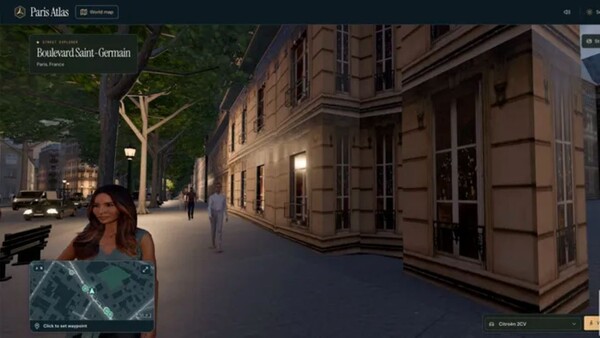
Paris Atlas was introduced as a use case for the new models. Thomas Licouart (토마 리쿠아르), an OpenAI developer, created a 3D virtual environment across Paris by combining street maps with French survey data to reflect more than 131,000 buildings. Users can explore in a browser as if walking through the real city or moving by car, and the model reflects changes when users provide revisions via screenshots.
API pricing was also adjusted. Astra's input and output token prices were cut by 20 percent from the existing GPT-6 Astra. It is priced at $8 per 1 million input tokens and $40 per 1 million output tokens, with cached input at $0.40. Sol kept the price of the existing GPT-6.1 Sol, set at $2 for input, $10 for output and $0.10 for cached input.
The scope of Ultrafast, an ultra-high-speed processing feature by subscription plan, was also expanded. Pro subscribers paying $200 per month will be able to use the feature on GPT-6.2 Sol for the first time, and Pro subscribers paying $500 per month can use it on both models. Enterprise and Edu users can access it if a workspace administrator enables the feature.
On safety, OpenAI said both models reached a “critical” threshold for cybersecurity capabilities. Astra also met a “high” threshold for AI self-improvement capabilities for the first time. OpenAI said it had tightened restrictions on high-risk cybersecurity support and built a control system called “Control Room” that can monitor or stop the model's tasks.
The launch shows OpenAI's strategy to expand ChatGPT from a simple question-and-answer tool into a work platform that produces actual documents, software and interactive services.
 Seung-a Yoo
ysah@d-today.co.kr