
A study found that if the cable TV industry disappears, 5.59 million contracts using 8VSB, a low-cost broadcasting service, would be affected. It said additional household costs from switching to IPTV could reach up to 760.9 billion won in the first year. With no clear service to replace existing low-cost broadcasting, user harm is a concern.
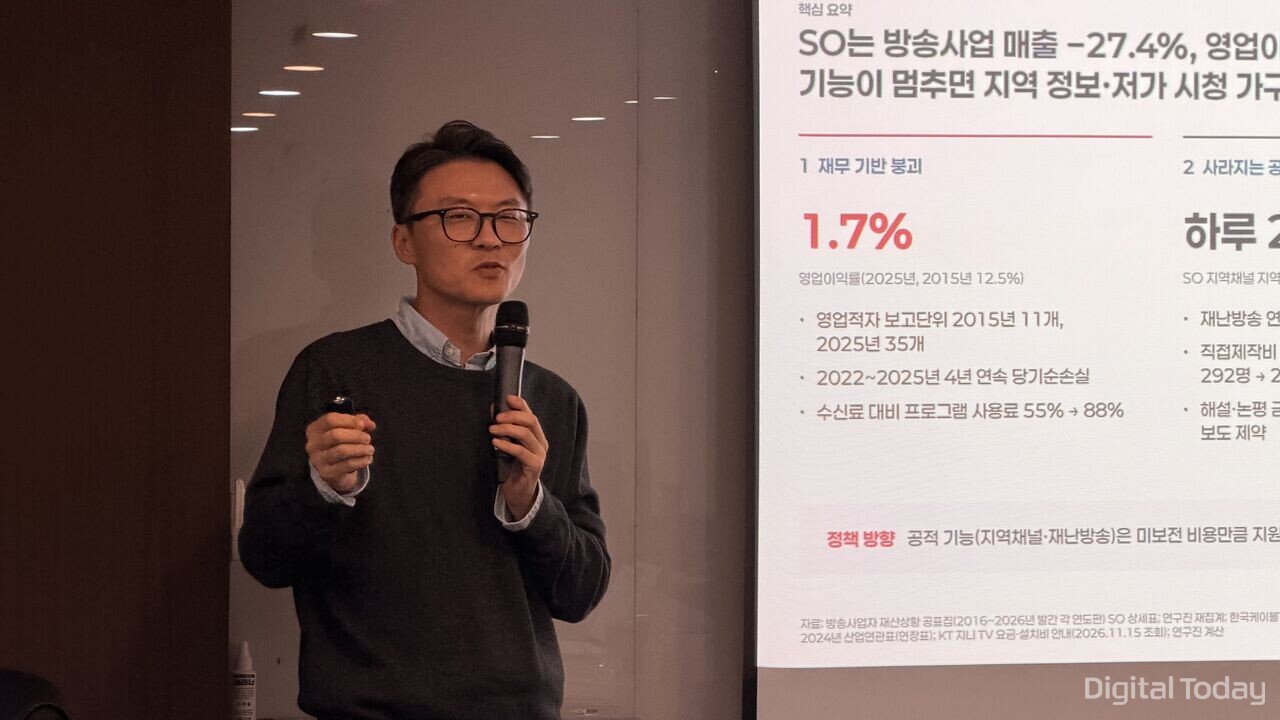
Professor Yong-hee Kim (김용희) of Sunmoon University’s business administration department presented the findings on Nov. 17 at a press study session hosted by the Korea Cable TV Broadcasting Association under the theme “What do regions lose if SO collapses?” The study analysed how a shutdown of functions by nationwide system operators (SO) would affect households, local economies and employment.
Kim said, “If 8VSB disappears, is there a service that can replace it? There is not.” He said IPTV would struggle to offer services at the same price level, and that damage to older and low-income users would be significant.
8VSB is a low-cost service that allows viewers to watch broadcasts without a separate set-top box. As of end-2024, it totalled 5,594,016 contracts, accounting for 45.9 percent of all SO contracts.
The study estimated that if 85 percent of personal 8VSB contracts switch to IPTV, additional household spending in the first year would be 385.1 billion to 760.9 billion won. Based on an 8VSB product priced at 4,400 won per month, switching to KT IPTV would generate additional costs per contract in the first year of 100,100 won to 197,780 won.
By region, the share of 8VSB was 95.9 percent in Daejeon and 88.8 percent in Gwangju, far above the national average of 45.9 percent. Older users may face difficulties installing set-top boxes and using digital services, in addition to higher fees.
Kim said, “IPTV operators have no incentive to take over users on low-cost plans, and the government also lacks the fiscal capacity to cover the fee gap.” He added, “If SO collapses all at once, major social confusion is inevitable.”
If SO disappears, value added falls 104.9 billion won... local jobs and public-interest services at risk
The study also found the economic ripple effects from the disappearance of the SO industry could be significant. Under its baseline assumptions, the research team estimated first-year output would fall by 207.75 billion won and value added by 104.86 billion won. It analysed the employment reduction effect at 763 wage workers, and put the fiscal burden from lower tax revenue and job-seeker benefits at 28.78 billion won.
It said 4,343 SO employees and 2,114 dedicated staff at partner companies would also be directly affected. Some 73.5 percent of partner-company staff belong to firms outside the Seoul metropolitan area. Kim stressed that once skilled personnel responsible for producing and reporting local content disappear, it is difficult to restore them.
The study also raised concerns about gaps in local public-interest services. SO local channels broadcast an average of 223 local news items a day and 6,115 disaster broadcasts a year across 78 broadcasting zones nationwide. It said replacement would not be easy because, unlike regional terrestrial broadcasters that operate on a metropolitan basis, SO channels deliver daily-life information at the city, county and district level.
The SO industry’s profitability has already deteriorated sharply. Broadcasting business revenue fell 27.4 percent to 1.64 trillion won in 2025 from 2.26 trillion won in 2015. Operating profit margin based on total revenue also dropped to 1.7 percent from 12.5 percent, and the industry recorded net losses for four consecutive years.
Kim assessed the improvement in last year’s operating profit margin to 1.7 percent from 0.5 percent as “a result made by cutting costs and investment.” He said it was a situation of trying to recover operating profit while undermining the capacity for a rebound.
To sustain the industry, the research team proposed easing contributions to the Broadcasting and Communications Development Fund and improving regulations on pay TV. SO currently pays 1.5 percent of broadcasting revenue as a contribution, but while bearing obligations to operate local channels, it is excluded from support under the Special Act on Support for Development of Local Broadcasting.
Kim stressed that “rather than setting aside a separate budget for government support, reducing costs borne by operators is effective.” He added that competition regulations should be eased and that unreimbursed costs for public functions such as local channels and disaster broadcasting should be supported.
 Seulgi Son
sageson@d-today.co.kr