
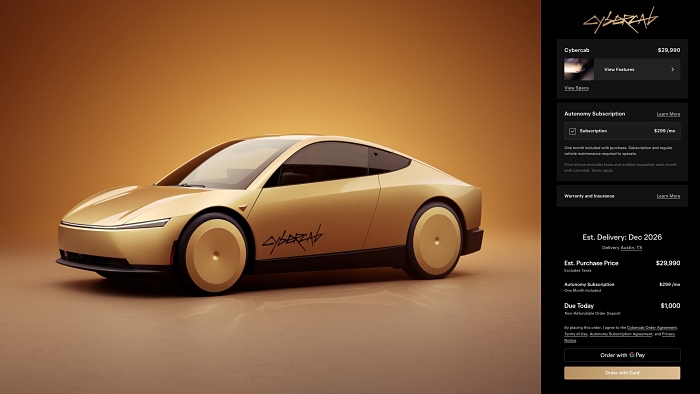
Tesla is starting personal sales of the Cybercab, a two-seat autonomous vehicle without a steering wheel.
The Cybercab costs $29,990. It is Tesla’s cheapest vehicle ever. To operate the vehicle, drivers need a $299-a-month self-driving subscription. The first month is free. A screenshot of Tesla’s order page shows deliveries could start as early as next month.
The launch is also drawing renewed attention to a head-shaving bet involving Tesla CEO Elon Musk (일론 머스크) and well-known IT YouTuber Marques Brownlee (마르케스 브라운리), also known as MKBHD. With the Cybercab launch timing tied to the bet’s conditions, interest is growing over what prompted Tesla to speed up the release.
• Tesla Cybercab starts personal sales at $29,990…cheap yet expensive • Why Tesla rushed the Cybercab launch…Elon Musk-MKBHD head-shaving bet reignites
Tesla’s Cybertruck is showing complex moves, including delaying discontinuation and raising prices despite controversy over a production halt.
With talk of a production stop approaching and even acquisition proposals emerging, attention is again on the business’s sustainability. Tesla is reported to continue production until late summer 2027. Over the past week it has raised prices twice and left only high-priced trims. Criticism has also emerged that it should have developed an SUV instead of the Cybertruck, drawing focus to other new-vehicle plans such as the Roadster.
• Will the Cybertruck production halt be reversed…a surprise proposal emerges to take over production • Tesla Cybertruck to be produced until late summer 2027…discontinuation delayed • Tesla Cybertruck raises prices twice in a week…only high-priced trims remain • “Tesla should have made an SUV, not the Cybertruck”…could the Roadster be shaken too?
Porsche has publicly drawn a line over how Tesla unveils its next-generation Roadster. Porsche CEO Michael Reiter said the company would not stage such a performance, targeting Tesla’s Roadster aerial-spin demonstration. The contrasting approaches pit Tesla’s eye-catching technology demos against Porsche’s emphasis on practical driving performance and product completeness.
• Porsche CEO takes a swipe at Tesla Roadster flight show…”We won’t stage that”
Tesla is seeking to solidify its position in global markets on the back of the sales competitiveness of its core electric models, the Model 3 and Model Y, while also accelerating expansion of its unmanned autonomous-driving business.
As attention focuses on whether it can maintain so-called “Apple-style dominance” after ranking No. 2 in global EV sales with just the two models, Tesla plans to push annual production of 1 million Cybercabs, investing about 4 trillion won in production. In Finland, road driving of the Cybercab is allowed even before the European Union’s final approval, drawing interest in the prospects for entering the European market.
• Tesla ranks No. 2 in global EV sales with only Models 3 and Y…can it keep “Apple-style dominance” • Tesla bets 4 trillion won on the Cybercab…aims to build 1 million a year • Tesla drives on roads in Finland…why allowed before EU final approval
Rapid growth in the artificial intelligence industry is affecting parts supply for automakers, raising worries about a “second chip crunch.” With demand surging for AI data centres and servers, supplies of key components including memory chips are tightening. EV maker Rivian said it is also struggling to secure memory, multilayer ceramic capacitors (MLCC) and substrates. Warnings are emerging that the AI boom could squeeze vehicle production and recreate the supply-chain crisis seen during the COVID-19 period.
• Auto industry warns of a “second chip crunch”…will the AI boom revive pandemic nightmares? • AI boom triggers shortages in EV parts…Rivian: “Hard to secure memory, MLCC and substrates”
China’s autonomous-driving sector is moving to secure alternative computing resources ahead of the possibility of tighter restrictions on Nvidia chip exports. Chinese autonomous-driving company Pony.ai has prepared measures for years to reduce reliance on Nvidia and has recently expanded use of Chinese-made chips.
• It can run without Nvidia…China’s autonomous-driving industry’s “Plan B”
As robots and humanoids are adopted in car production sites in earnest, the shift toward manufacturing automation is accelerating. Rivian has unveiled a sweeping automation plan to replace 80 percent of factory jobs with robots. Mercedes-Benz has begun deploying humanoids on production lines to handle parts transport. Automakers’ use of robots is expanding beyond simple repetitive tasks to cover the broader production process.
• “Robots will take 80 percent of factory jobs”…Rivian’s sweeping automation plan • Humanoids deployed on Mercedes production lines…DeepMind’s “Apollo 2” carries parts
South Korea’s mobility platform industry is accelerating efforts to improve profitability and expand business. With Socar and Tmap Mobility both posting operating-profit turnarounds in the third quarter, Socar has also moved to cooperate with Hyundai Motor in autonomous driving alongside Apex Mobility. Backed by improved results, the companies are seeking to boost profitability in existing mobility businesses while expanding into future areas such as autonomous driving.
• Socar posts 9.8 billion won operating profit in Q3…up 43 percent from a year earlier • Tmap Mobility posts 3.3 billion won operating profit in Q3…profitable for consecutive quarters • Socar signs MOU with Apex Mobility and Hyundai Motor on autonomous-driving business cooperation
An electric bicycle supporting USB-C charging has appeared at a price below 1,000 euros. Unlike existing e-bikes that relied on dedicated chargers, it is a product that can use a laptop charger as-is. A universal standard promoted for charging convenience is spreading to entry-level e-bikes.
• E-bikes enter the USB-C charging era…an affordable model emerges that is 75 percent cheaper than Rivian
 Hong Jin-joo
hongjj@d-today.co.kr