
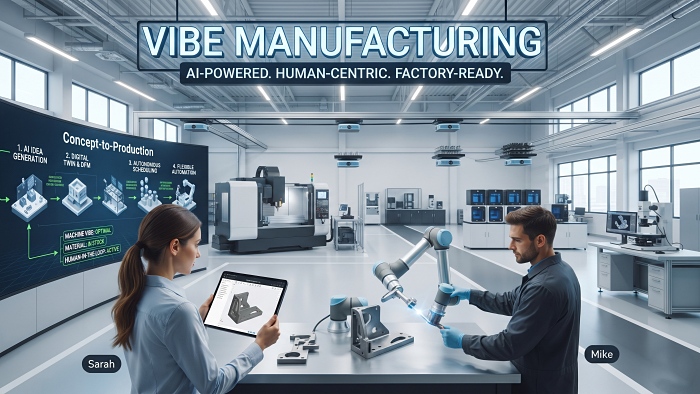
Vibe manufacturing, which uses AI to make hardware, is emerging as a new trend following vibe coding for making software, U.S. business outlet Business Insider reported on Saturday. It involves sending files designed by a chatbot to a manufacturer or a home 3D printer to produce a physical item.
Jeff Deehan (제프 디한), a real estate developer in East Lansing, Michigan, described the parts he needed for OpenAI's GPT-6 Astra voice mode. Within about 5 minutes, the chatbot designed a steel part. The chatbot also downloaded a DXF file and completed an order on the website of custom sheet-metal fabricator SendCutSend, with a payment amount of $156. The part arrived 10 days later. Deehan said, "I made a part with my voice in 10 minutes."
Open-source text-to-CAD tools are also popular. The tool developed by Amy Zhou (아마 저우) and Jake Fitzgerald (제이크 피츠제럴드) has more than 23,000 stars on GitHub. Fitzgerald used the tool to design a sheet-metal robot arm and had it made for about $200. Its reach is 0.6 metres. He explained that a few months ago he spent about $2,000 as design errors accumulated, but those problems disappeared after adopting GPT-6 Astra.
Sourish Sharma (소리시 샤르마), a 20-year-old maker in Britain, converted MRI data into a 3D printing file with a single prompt and printed a life-size brain model. He said, "AI completely replaces CAD engineering."
The limits are also clear. The more complex a product is, the harder it becomes, and trial and error can be costly. Arthur Prince (아르튀르 프랭스), an IT worker in France, designed a children's toy that creates stories and images by voice within a week. After having Claude review the design made by GPT-6 Astra, he ordered 10 units from Chinese manufacturer JLCPCB for about 500 euros. David Plakon (데이비드 플라콘) in Austin, Texas, revised and printed the same design 15 times on a 3D printer. He said, "AI is great, but it is not perfect."
 Hyunwoo Choo
cookinpapa@d-today.co.kr