
South Korea’s Ministry of Science and ICT said on Saturday it has fully overhauled the screen layout and user interface/user experience (UI/UX) of the pan-government Integrated Research Support System (IRIS) to reduce researchers’ administrative burden. It aims to help researchers focus more on their work through automated entry of paper information and expanded mobile services.
IRIS is an integrated system that supports applications for national research and development (R&D) projects, evaluations, research fund management and performance reporting online. Since its launch in January 2022, it has integrated project management methods that differed by ministry, but it has been criticised for excessive manual input, complex screen layouts and a lack of mobile services.
The revamp focuses on four areas: automating research performance registration, expanding mobile services, unifying standard forms and screen layouts, and improving user convenience.
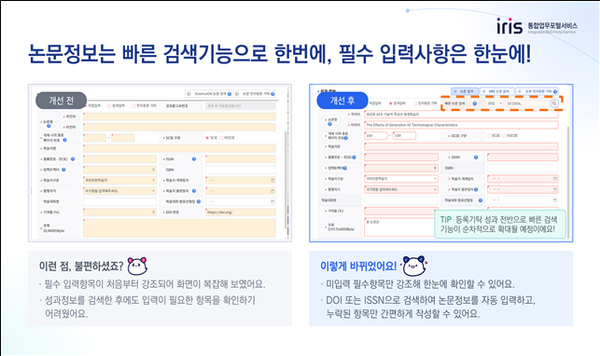
It introduces a function that automatically inputs paper information by linking the global academic database Web of Science and the National Researcher Information System (NRI). When users enter paper identification information, bibliographic details such as the title, authors and journal name are automatically filled in, reducing repetitive manual input.
It also expands mobile services. It will create 24 mobile-only services that allow users to check project announcements, the progress of research project submissions and agreements, and the status of research fund payments. It will enable simple administrative procedures such as research ethics consent to be handled on mobile phones and add a schedule notification function.
The system also improves the screens used to write R&D plans and reports. It aligns terminology and the order of items on the screen with standard forms under the National Research and Development Innovation Act and places mandatory input items at the front. Guidance text scattered across the screens is consolidated into a unified information box and help buttons.
It will also introduce a “project information integrated pop-up” that allows users to view an entire plan at once, and a “collapse/expand” function on the research fund input screen to make writing easier.
The ministry has been running a pilot of the revamped system since mid-last month. It plans to check system stability under simultaneous access and supplement improvements through the distribution of online user guides and satisfaction surveys.
Park In-gyu (박인규), head of the Science and Technology Innovation Office at the ministry, said, “This IRIS revamp is meaningful in that it reflects, as a top priority, the voices from research sites that have complained about complex administrative procedures.” He said, “We will complete it as a user-centred research support platform so that researchers can escape administrative burdens and fully immerse themselves in R&D.”
 Jin-ho Lee
jhlee26@d-today.co.kr