
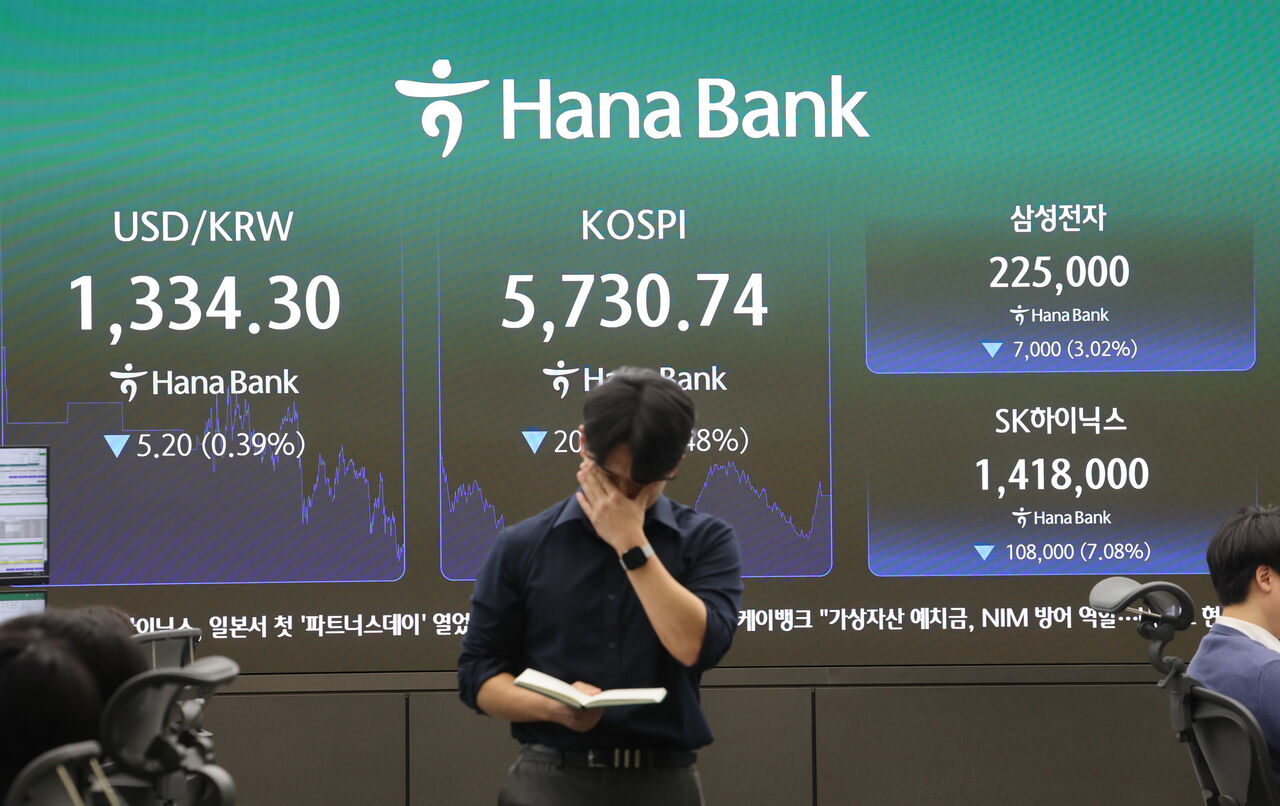
South Korean stocks this week are expected to test the scope for a rebound after a steep October selloff. With U.S. midterm elections and employment data scheduled, the key will be whether worries over artificial intelligence investment costs and foreign flows can ease.
The KOSPI on Oct. 30 closed at 5,730.74, down 206.92 points, or 3.48 percent, from the previous session. It fell as far as 5,599.42 intraday, and a sell-sidecar was triggered. The KOSDAQ also ended down 3.83 percent at 724.38. The KOSPI and KOSDAQ fell 16.2 percent and 15.4 percent, respectively, over October.
U.S. stocks also swung sharply on the burden of AI investment costs. On Oct. 30, the Dow Jones Industrial Average closed down 1.09 percent at 51,770.31, the S&P 500 fell 1.82 percent to 7,580.07 and the Nasdaq ended down 2.86 percent at 25,437.00. Intel plunged 28.6 percent, Nvidia fell 4.2 percent and AMD sank 10.9 percent, while the Philadelphia Semiconductor Index dropped 7.2 percent.
The main issue shaking markets recently is not AI demand itself but who can bear the huge investment costs. Amazon's cloud business growth and data centre demand stayed solid, but concerns over cash flow burdens from increased investment came into focus.
Alphabet and Meta are also continuing large-scale AI investment, and market attention is shifting from revenue growth to investment payback and fundraising capacity.
The industry says it is hard to conclude demand across the AI industry has collapsed. Recent results showed demand for AI cloud and data centres is being maintained.
Still, differentiation could become clearer between companies that can keep investing with their own cash generation and those with a high reliance on external borrowing.
South Korean stocks are being hit by the same factors. Samsung Electronics and SK Hynix earnings and the outlook for the memory market remain solid, but whenever worries rise over AI firms' investment funding, foreign selling concentrates in heavyweight semiconductor stocks. On Oct. 30, heavy foreign selling also deepened the index fall.
Still, around the 5,600 level, low-price buying from pension funds and others also flowed in, confirming the possibility of downside support. The industry sees the KOSPI, having fallen well below its 200-day moving average, needing a process of confirming a bottom before a short-term V-shaped rebound. It also says there is an overhang of shares around 6,600 to 7,000, where trading was concentrated during the earlier upswing, making it difficult to recover in one go even if a rebound occurs.
The first variable this week is the U.S. midterm elections on Nov. 3. U.S. voters will choose the entire House of Representatives and some Senate seats. Depending on the results, the direction of fiscal and regulatory policy and policies related to AI and data centres could also be affected.
Markets are focusing not only on which party wins but also on the fact that the uncertainty of an election itself will be resolved. In the past, after midterms, political and policy uncertainty often fell and U.S. stocks stabilised. With South Korean stocks recently sensitive to external factors, the key is whether risk aversion can ease after the election.
The U.S. Treasury's debt issuance plans are also a factor that will influence long-term yield moves. Quarterly funding needs will be disclosed on Nov. 2, and the quarterly debt issuance plan is set to be announced on Nov. 4. If bond supply rises much more than expected, long-term yields could climb again, simultaneously increasing AI firms' fundraising burden and the discount rate on growth stocks.
The U.S. October employment report will be released on Nov. 6. If employment is stronger than expected, the possibility of additional tightening by the Federal Reserve could come back into focus. Conversely, if wage and job growth cool at an appropriate pace, U.S. Treasury yields could stabilise, potentially helping South Korean growth stocks.
International oil prices also remain a burden. On Oct. 30, WTI settled at $104.12 a barrel and Brent ended at $117.63. With tensions in the Middle East continuing, higher oil prices are again stoking both inflation and interest rates.
The industry sees it as difficult for investment sentiment to recover quickly while oil prices stay above $100 a barrel. Conversely, it says if oil drops below $90, the burden from inflation and long-term yields could ease at the same time, creating a trigger to reverse the recent selloff.
In South Korea, whether flows normalise is important. While foreign selling has been large recently, the buying capacity of individuals and institutions to absorb it has weakened compared with the past. Larger shareholder returns are supporting the downside in some heavyweight stocks, but a noticeable drop in the intensity of foreign selling is needed to expect a trend rebound.
Semiconductors are still cited as a key sector. That is because medium- to long-term earnings forecasts for Samsung Electronics and SK Hynix have not been significantly damaged, and demand visibility through the memory supply structure and long-term contracts is also being maintained. Still, investors also need to check whether AI firms' credit risk stabilises and whether actual capital spending continues.
Ultimately, South Korean stocks this week are expected to be a test of whether they can escape October's excessive fear. If the U.S. midterms reduce policy uncertainty and employment and the Treasury's issuance plans do not increase the burden from long-term yields, the KOSPI could show a move to raise its bottom from the 5,600 level.
If AI credit risk, oil prices and foreign selling continue, it will likely take more time before a full trend rebound.
Roh Dong-gil (노동길), a researcher at Shinhan Investment, said, "There is no need to rush right now." He said short-term 대응 should focus on banks, defensive stocks and high-dividend stocks rather than quickly increasing exposure, and he sees a 3-month KOSPI band of 5,200 to 6,600 points.
Kim Jong-min (김종민), a researcher at Samsung Securities, assessed the current market as the final phase of a correction before a new upcycle. He said it is standard to stay on the sidelines until signals of a technical trend reversal are confirmed rather than betting by predicting the bottom.
Lee Jae-won (이재원), a researcher at Yuanta Securities, said, "In the short term, foreign selling pressure could lead to doubts about sustainability, but ultimately it is small volatility occurring within the larger framework of change." He said gradual increases in exposure are needed while checking for stabilisation in credit risk and a recovery in foreign flows.
Seo Sang-young (서상영), an executive director at Mirae Asset Securities, said, "This week, changes in long-term yields driven by U.S. employment data and the Treasury's debt issuance plans, earnings and investment efficiency at major AI and semiconductor companies, and the U.S. midterm election results are expected to determine market direction." He said whether interest rates and AI-related credit spreads stabilise at the same time is an important criterion for judging the durability of a rebound in technology stocks.
 Oh Sang-yup
yub@d-today.co.kr