
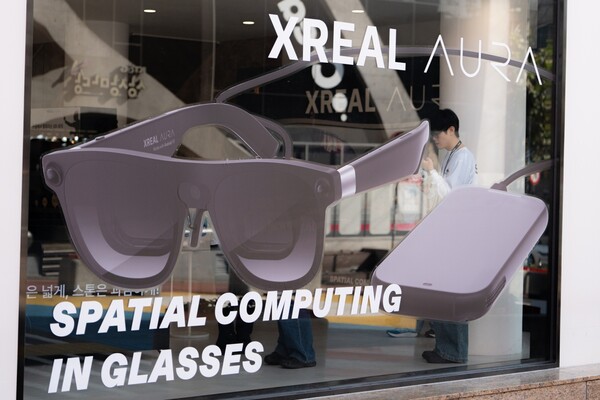
When you put on glasses that look like sunglasses, multiple virtual screens unfold before your eyes. You can move the screens or adjust their size with your fingers. It creates a spatial computing environment that uses up to five screens without a separate monitor.
Aura from XR glasses maker Xreal offers that experience. Xreal held a hands-on event at Hongdae Square in Seoul on Oct. 30 and introduced Aura’s main features.
Up to 5 virtual screens in front of your eyes, with hand gestures to adjust size and position.
Aura is an XR glasses device that uses an optical see-through method. It lets users view virtual screens while seeing the real world through transparent lenses. It provides a multi-window environment that allows multiple virtual screens without a physical monitor. Using wired mirroring, it expands a laptop or handheld game device screen into a large display inside the glasses.
In hands-on use, the ability to display up to five screens at the same time without a separate monitor stood out. You can write a document on one screen while placing an internet browser or video on another.
The virtual screens changed position and size with finger movements. Even with multiple windows open, users could still see the surrounding space. An Xreal official said, "You can work while easily moving between various apps," adding that this is "where Aura differentiates itself from other products."
The control method is also convenient. Based on Android XR, it supports hand and voice input. Users can move windows by bringing fingers together or spreading them apart, enabling intuitive control. It also supports a separate keyboard, trackpad and game controller. It also includes Google’s generative AI model, Gemini. Gemini understands what Aura users are looking at on the screen and answers related questions or guides them on how to perform tasks.
Weighing under 95 grams, with Sony OLED and a Qualcomm chip.
Aura reduces the burden of wearing it while packing in various features. It adopts a lightweight design that cuts weight to under 95 grams. Xreal applied a detachable computing structure to do this. It placed the main computing unit and battery not in the glasses body but in a separate small compute puck. Users must connect Aura and the puck with a wired cable, a factor to consider for portability.
The display uses Sony’s micro organic light-emitting diode (OLED) technology. It supports a 70-degree field of view, 1200p resolution and up to a 120 Hz refresh rate. It uses Qualcomm’s Snapdragon Reality Elite platform as its processor. Xreal combines that with its in-house X1S chip to support XR screen operation and spatial computing functions.
It also focused on visual comfort. Aura received five certifications from certifying body TUV Rheinland: eye comfort five-star rating, high visibility, low blue light, flicker free and color accuracy. It also applies Sound by Bose technology to enhance expression in the mid and high frequency ranges.
Turning your head makes the entire concert hall vivid, with 360-degree video as well.
It also expanded the content ecosystem. Xreal said Aura provides more than 150 XR-only experiences from launch. Users can also use mobile apps and games listed on Google Play.
Among services in South Korea, it supports Naver’s CHZZK. With 180-degree and 360-degree videos provided by CHZZK, users can enjoy immersive content that differs from standard flat videos.
When a concert video uploaded to CHZZK was played, different parts of the venue appeared in 3D depending on where the viewer looked. From the front, the artist performed on stage. When the viewer tilted their head upward, the ceiling and lighting came into view. It was clear enough to make out even the accessories worn by the artist. It was immersive enough to feel as if you were inside the concert hall.
Aura also supports electrochromic dimming. It darkens the lenses to help users focus on virtual screens rather than the surroundings. Turning off dimming lets users consume content while checking the surrounding space.
Xreal also developed a dedicated game controller in collaboration with GameSir. The controller includes a dedicated Gemini key, allowing users to call up AI functions during gameplay.
Aura has been available for purchase since Oct. 30 through Xreal’s official Naver Smart Store. It launched in two versions: a 12GB RAM and 256GB storage model and a 16GB RAM and 512GB storage model. Through December, they can be purchased for 1.69 million won and 1.99 million won, respectively. Products will be shipped sequentially starting in late November.
 Jin-ho Lee
jhlee26@d-today.co.kr