
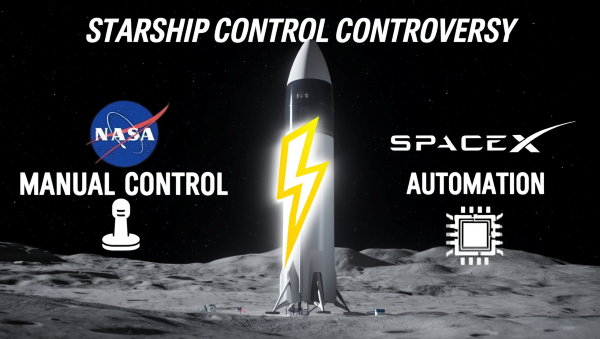
Hyunwoo Choo of DigitalToday reports that SpaceX is shifting its centre of gravity from a core U.S. government space contractor to a company that prioritises its own business, increasing the burden on the U.S. space agency NASA's crewed lunar exploration plans.
According to IT outlet Ars Technica on Oct. 29 local time, SpaceX continues to carry out existing contracts with NASA and the U.S. Space Force, among others. But it is not as active as before in pursuing large new contracts in traditional launch and spaceflight areas.
The main backdrop is a change in its profit structure. SpaceX is looking to Starlink and AI-related data infrastructure as its main future revenue sources. In a recent third-quarter 10-Q filing, the company said it is allocating substantial launch capacity to its connectivity business segment, and will also allocate substantial launch capacity to its SI segment going forward.
The problem is that NASA has already sharply increased its dependence on SpaceX. NASA provided $278 million in 2006 to support development of a cargo spacecraft for International Space Station resupply, and spent $1.6 billion in 2008 on contracts for 12 Dragon cargo flights. Over the past 20 years, the total value of contracts NASA has entrusted to SpaceX is about $20 billion. As a result, NASA secured low-cost launch services and crewed low-Earth orbit transport capability, but the International Space Station and the Artemis programme became more dependent on SpaceX.
The biggest variable is the crewed lunar lander project. NASA awarded SpaceX a $2.89 billion contract in 2021 for a Starship-based crewed lunar lander. But Starship has yet to complete key tasks such as on-orbit propellant transfer and storage. The most recent target time frame presented by NASA and SpaceX is early 2027.
The number of required launches is also a burden. An internal estimate at NASA's Johnson Space Center is that about 22 Starship launches are needed just for an uncrewed lunar landing demonstration. Assuming an initial cost of $100 million per Starship launch, launch costs alone exceed about $2 billion.
NASA is also burdened by the fact that in recent weeks SpaceX notified at least two manufacturers of cargo spacecraft for lunar exploration that it would no longer provide related launch services. These companies had been preparing cargo transport tied to NASA's lunar base. As a result, some companies are now in a position where they need to consider Blue Origin's New Glenn or other alternatives.
Blue Origin changed its lunar lander design to meet NASA's schedule. It revised its concept from one centred on the large Blue Moon Mark 2 to a faster approach that does not require low-Earth orbit refuelling. Still, Blue Origin also experienced an explosion of a New Glenn launch pad, and its orbital missions so far total three. That means that if NASA is to reduce its reliance on SpaceX, Blue Origin ultimately needs to prove real execution capability.
The change shows that the axis of U.S. space development is shifting from government-contract 중심 to privately funded revenue businesses. NASA's crewed lunar exploration plans are now being directly affected not only by technical difficulty but also by private companies' priorities in allocating resources.
 Hyunwoo Choo
cookinpapa@d-today.co.kr