
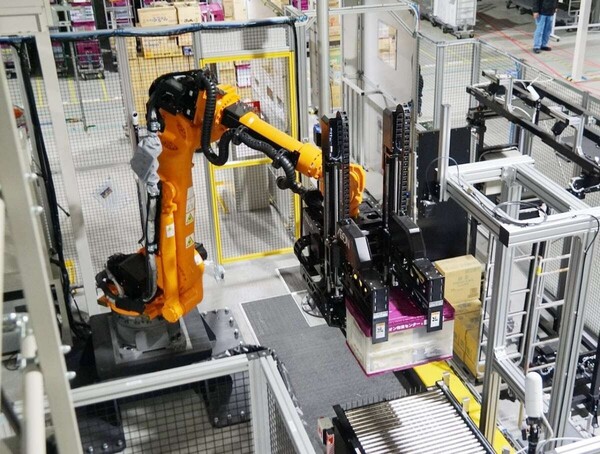
Japanese retailer Aeon has begun full operations at a logistics hub using Physical AI, moving to expand delivery automation. The facility has robots that sort products and load them by store. Aeon aims to raise its work automation rate, now about 50 percent, to 80 percent by 2030.
ITmedia in Japan reported on Oct. 30 that Aeon and robot control software company Mujin unveiled a delivery hub called Aeon Kawaguchi-Higashi XD in Kawaguchi, Saitama prefecture. The facility supplies goods to about 200 My Basket small supermarket stores in the Tokyo metropolitan area, and began full operations that day.
More than 90 robots were deployed at the site. Automation covers tasks from using sensors to identify incoming case goods and place them on conveyors to transporting products with automated guided vehicles. In particular, 82 automated guided vehicles move individual items to temporary storage areas to support the logistics flow.
The process drawing the most attention is loading products. Robot arms automatically stack goods when items to be shipped by store are loaded onto cart racks. Unlike conventional industrial robots that repeat fixed motions based on pre-programmed instructions, robots using Physical AI judge the loading order and method themselves by considering factors such as weight and shape. A key feature is that they adjust the work to the situation to prevent loads from collapsing.
Aeon said the hub’s work automation rate reaches 50 percent of the overall process. It also achieved the effect of reducing labour by about 39 people a day through the introduction of robots. Hiroki Yamamoto (야마모토 히로키), president of Aeon logistics unit Aeon Global SCM, described the robots’ productivity as "3 to 4 times" that of people.
The facility is the first case of automating a series of logistics flows from product sorting to loading by store. Aeon is also considering a system to automate the entire process from receiving to shipping. It plans to raise the automation rate to 80 percent by 2030 and, with this hub as a starting point, expand automation to logistics facilities for supermarkets and drugstores within the group.
Aeon is accelerating logistics automation against a backdrop of chronic labour shortages in Japan’s distribution and logistics industries. As the working-age population continues to decline, it is becoming increasingly difficult to secure staff for labour-intensive tasks such as transport, sorting and loading. Physical AI can recognise surrounding environments and judge work methods beyond simply repeating fixed motions, and is emerging as an alternative for on-site tasks that existing automated equipment has struggled to handle.
Market growth prospects are also bright. Indian research firm Acumen Research and Consulting estimated that the global Physical AI market will expand to $82.79 billion in 2035 from $5.02 billion in 2025. As more cases in logistics sites lead to actual equipment investment and operations, the industrial potential of Physical AI is also growing.
The Japanese government also views Physical AI as a strategic area for strengthening industrial competitiveness. The Sanae Takaichi administration highlighted that Japan holds extensive industrial robots and manufacturing-site data, and presented Physical AI as one of 17 strategic areas. It envisions pursuing public-private investment of about 10.5 trillion yen by 2040.
Still, securing safety is cited as a prerequisite for Physical AI to spread quickly at logistics sites. That is because workers could be harmed if AI misjudges work situations or robots malfunction. Kaori Iwasaki (이와사키 가오리), a senior principal research fellow at The Japan Research Institute, pointed out that safety devices should be put in place so as not to harm people. "We need to start from areas we can do, accumulate knowledge and solve challenges," she said. "It will take time on the order of 10 years to reach a completed form."
Aeon’s latest logistics hub shows Physical AI is beginning to be used beyond the research and development stage as a means to ease labour shortages and improve productivity at actual distribution sites. If the scope of automation expands from receiving to shipping, changes are expected in how Japan’s distribution logistics work is carried out.
 Jinju Hong
hongjj@d-today.co.kr