
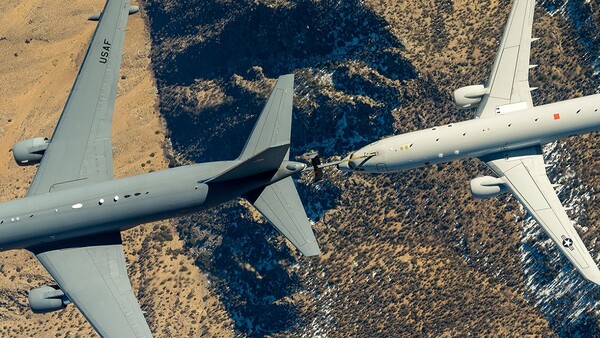
[DigitalToday reporter Choi Jae-won (최재원)] The U.S. Air Force is pushing to develop a system that uses AI to automatically analyse pilot mistakes and warning signs that occur during aerial refuelling. It aims to shift training assessments that relied on instructors’ subjective judgement to a data-driven approach to improve safety and mission performance.
On Oct. 30 (local time), IT outlet TechRadar reported that the U.S. Air Force is considering introducing technology that uses AI to analyse camera footage installed on tankers to identify errors in the aerial refuelling process and provide objective evaluation material after missions.
The system uses computer vision and machine learning to track the movements of the tanker and the aircraft receiving fuel. It measures factors such as distance and relative position between aircraft, approach speed and alignment to detect situations that deviate from standard refuelling procedures.
The movement of the refuelling boom, the fuel delivery device, is also subject to analysis. The AI is designed to compare the boom’s movement path with the aircraft trajectory to identify dangerous movements or abnormal manoeuvres that could occur during refuelling.
Current U.S. Air Force aerial refuelling training assessments largely rely on instructors’ observations, pilots’ self-evaluations and manual reviews of recorded video. Critics say judgments can vary by evaluator even for the same manoeuvre, and brief mistakes may be missed.
The new system visualises analysis results through graphics, colour-coded performance maps and chronological event logs. It is intended to help pilots and instructors easily identify problems that occurred in specific manoeuvres and find areas for improvement.
The initial development target is Boeing’s KC-46 Pegasus aerial refuelling tanker. The KC-46 remotely operates the refuelling boom using cameras and a 3D display, but technical issues have been repeatedly raised with the existing video system. The AI technology, however, is an evaluation tool that analyses training outcomes, not an autonomous system that directly controls the refuelling equipment.
The U.S. Air Force will accept development proposals through the Small Business Technology Transfer (STTR) programme until Nov. 25. It ultimately plans to secure a prototype that can be applied to at least one type of receiver aircraft and link it to the existing flight training system.
It is also considering expanding to flight simulators and virtual reality (VR) and augmented reality (AR) training, and using it for pilot evaluations of other military aircraft.
 Choi Jae-won
ittt_0801@d-today.co.kr