
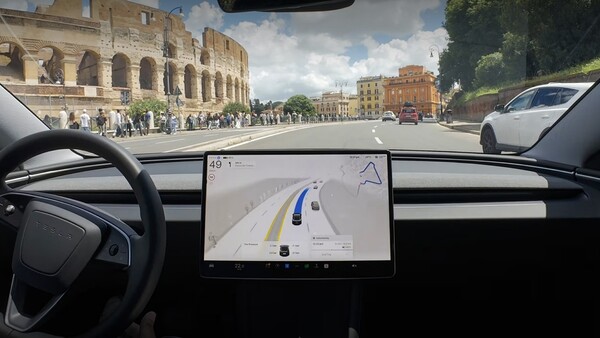
[Digital Today reporter Jae-won Choi (최재원)] Tesla's advanced driver assistance system FSD (Full Self-Driving) showed both its driving capability and its limits in a challenging European downtown road environment. It made it through narrow alleys and steep sections, but the driver had to step in for traffic-rule judgement and route finding.
On Oct. 29 (local time), InsideEVs reported that YouTube channel "robot*irl" released a 32-minute video testing FSD in a Tesla Model Y in Bratislava, the capital of Slovakia. Local viewers selected difficult driving sections themselves, including narrow roads and complex intersections.
The vehicle handled a sharp turn across tram tracks without trouble. It also passed a steep slope and a narrow space between parked vehicles and a trailer. It was also shown leaving room for pedestrians, avoiding a dog and reversing to make way for an oncoming vehicle.
But the driver had to take control after the system failed to properly recognise an entry restriction. On a steep dead-end road, the driver finished the manoeuvre after judging there was not enough space in front of the vehicle. A routing error also appeared after reaching a waypoint, with the system trying to enter farther inside unnecessarily.
Sign interpretation and steering stability were also cited as problems. In a narrow passage, it tried to approach in a direction different from the arrow indicating the direction of travel. The steering wheel also shook repeatedly, as if hesitating over lane selection.
Tesla won approval in the Netherlands in April for its supervised FSD system after at least 18 months of evaluation. The permitted scope later expanded to 10 European countries including Slovakia and Latvia, but it has not been approved in the remaining 17 EU countries.
Germany stressed that the driver must always be responsible and said the term "Full Self-Driving" could cause misunderstanding. Tesla uses the name Tesla Assisted Driving in Europe.
The test showed the possibility that FSD can cope with complex roads, while reaffirming that it remains an assistance system that still requires continuous driver monitoring.
 Jae-won Choi
ittt_0801@d-today.co.kr