
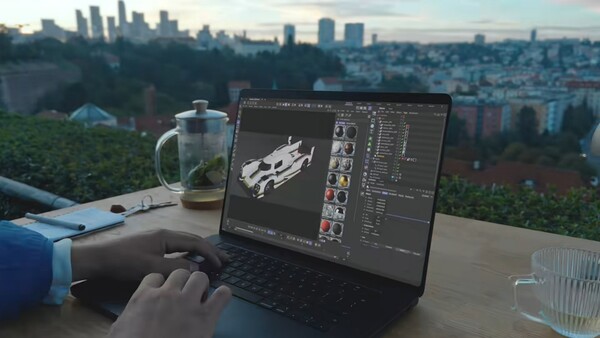
[Digital Today reporter Choi Jae-won (최재원)] Apple’s first touchscreen MacBook Pro is drawing attention for the display’s picture quality rather than its touch function. It is being assessed as setting a new standard for professional laptop screens with an overwhelming contrast ratio, brightness and an ultra-thin panel design.
TechRadar reported on Oct. 29 that Apple’s new MacBook Pro is equipped with a PROLED XDR display that supports a 10 million-to-1 contrast ratio and a peak brightness of up to 2,000 nits in small areas.
The new display is built with a tandem OLED structure that combines two OLED emissive layers. It precisely controls the brightness of individual pixels to deliver deep blacks and detailed highlights at the same time.
The panel is less than 1 millimeter thick, but about 50 layers are integrated inside. Thirty layers are used for the dual OLED structure alone, and some layers are only 1 nanometer to several hundred nanometers thick. A thin-film transistor (TFT) glass substrate that drives the display is placed on the back.
A digitizer that detects touch input is also integrated into the panel. It implements touch technology used in the iPhone and iPad for a laptop environment.
Eighth-generation OLED manufacturing equipment is used for production. Apple did not disclose the manufacturer’s name, but it said large-scale equipment and customized processes can improve yield and efficiency.
Differences in picture quality also appeared versus competing products. The Lenovo Yoga Pro 9i Aura Edition, cited as a comparison, has a 1 million-to-1 contrast ratio, while the MacBook Pro has 10 million-to-1.
Apple supports peak brightness of up to 2,000 nits in HDR video and outdoor SDR environments, and sustained full-screen brightness of up to 1,000 nits. It also offers anti-reflective coating and a nano-texture glass option.
The outlet said, "Comparing the actual products, the MacBook Pro had less light reflection, and color reproduction was stable even at oblique angles." Both standard glass and nano-texture glass apply a coating that reduces fingerprints and oil.
Apple stressed that with a wide color gamut and precise color reproduction, it can be used as a professional color reference display for photo and video editing.
Still, areas such as the high price and screen wobble from touch operation still need to be verified. An analysis said picture quality, rather than touch functions, could be the new MacBook Pro’s core competitive strength.
 Choi Jae-won
ittt_0801@d-today.co.kr