
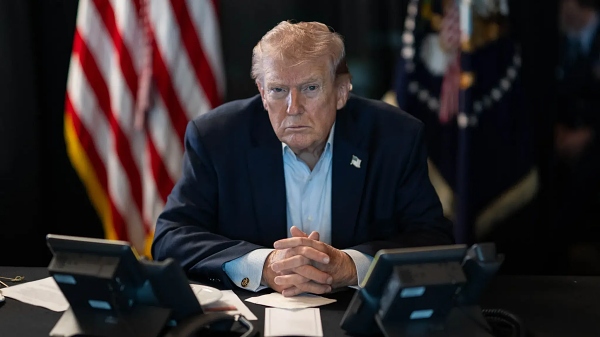
U.S. President Donald Trump has defined imports of foreign-made industrial robots as a national security threat and ordered negotiations with U.S. trade partners to adjust imports.
On Oct. 29 local time, IT media outlet Ars Technica reported that Trump said in a proclamation issued on Oct. 28 that the United States could take additional steps, including tariffs, quotas and various fees, if no agreement is reached.
The move targets factory robots, industrial machinery and related parts used across U.S. manufacturing. Automakers such as General Motors, Ford and Tesla, and aerospace and defense firms such as Boeing and Lockheed Martin, could be directly affected because they have a high reliance on robot equipment from overseas companies.
In the proclamation, Trump said industrial robots and machinery are essential to producing U.S. military weapons systems and called them the driving force behind all critical infrastructure sectors of the U.S. economy. It also presented findings from an investigation led by Commerce Secretary Howard Lutnick (하워드 러트닉). The investigation found that the imports pose risks to the U.S. industrial base and threaten the country’s long-term competitiveness in areas becoming increasingly important to national security.
The U.S. Department of Commerce also pointed to security and safety risks. It said foreign-made robots and machinery carry inherent security and safety risks and could lead to serious cybersecurity vulnerabilities that could cause severe consequences. That is why the measure has expanded beyond a simple trade issue into supply chain and security concerns.
The Trump administration already barred some new models of foreign-made robots in July 2026 through the Federal Communications Commission (FCC). The products covered then included robot vacuum cleaners, quadruped robots and humanoid robots. Industrial robotic arms and fixed robots widely used in auto plants and logistics warehouses were exempt. The new proclamation effectively expands the review scope to on-site industrial robots that had remained outside the earlier restrictions.
The United States and its trade partners must reach a new agreement within 180 days of the proclamation’s effective date to adjust imports of robots, industrial machinery and parts. If talks fail, the president can add tariffs, duties, quotas and fees. The actual cost burden will fall on U.S. companies importing foreign-made robots. That raises the likelihood that operating costs at U.S. manufacturing sites will rise.
The burden is likely to increase because it is tied to the structure of U.S. manufacturing. The International Federation of Robotics (IFR) said new industrial robot installations in the United States reached about 38,500 units in 2025, lifting the country to the world’s second-largest market. But the United States has virtually no alternative domestic suppliers in the large industrial robotic arm segment. Automotive and aerospace companies mainly use products from the so-called big four suppliers, including Fanuc, ABB, Yaskawa and Kuka, which are headquartered in Japan, Switzerland and Germany.
Amazon is no exception. It has sharply increased in-house robot development and production, but it still uses some foreign-made equipment, including robotic arms from Japan’s Fanuc. It shows that U.S. companies may be building internal production capacity but find it difficult to end reliance on overseas suppliers in the short term.
Trump also acknowledged that reality in the proclamation. It said U.S. robot companies are unable to produce enough industrial robots to meet national security demand, and that the United States depends on overseas imports for most robots, industrial machinery and related parts. It ultimately means the United States is pushing to tighten import restrictions while carrying a supply gap at home at the same time.
A key issue is whether the administration moves to an outright import ban or settles on a tariff-focused approach. The proclamation prioritised leaving open the possibility of imposing tariffs rather than fully blocking imports. It also leaves open the possibility that the Trump administration could allow the use of foreign-made robots through exemptions, as in the Intel case, even if there is a nominal ban. As a result, along with the outcome of the 180-day talks, what waivers and exceptions apply to U.S. manufacturers is expected to emerge as a key variable.
 Jinju Hong
hongjj@d-today.co.kr