
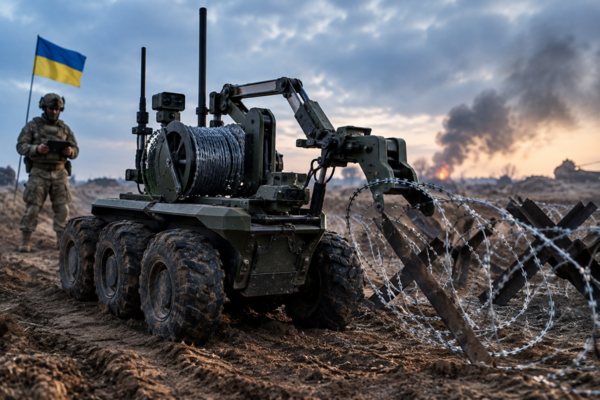
Ukraine's military has deployed remotely controlled ground robots for high-risk work installing barbed wire and other defensive obstacles in open terrain along the front line. The military is replacing defensive line construction tasks that required engineers to expose themselves with ground drones, IT outlet TechRadar reported on Oct. 29 (local time).
Photos released by Ukraine's ground forces show a six-wheeled ground robot. The manufacturer and model are not known. The equipment mounts a special frame over the wheels to secure a roll of barbed wire and, as it moves, sequentially unspools materials across designated sections to install obstacles. A slanted support helps prevent the wire from unspooling all at once.
Ukraine's 16th Independent Support Brigade is responsible for operating it. Operators remotely control the equipment while staying under cover. That reduces the need for combat engineers to leave protected positions and lay barbed wire by hand in exposed terrain.
Ukraine's ground forces said on social media that installing obstacles in open areas has always been a dangerous mission. "Installing barriers in open areas is always dangerous for combat engineers," it said. "Now this hard work is handled by ground drones," it added.
The case aligns with a broader trend in Ukraine to expand the scope of unmanned ground equipment. Similar systems are already used to transport ammunition and essential supplies. The focus has been on reducing the frequency of dangerous resupply missions. This time, the use has expanded beyond transport to building defensive facilities.
The scale of operations is also rising quickly. According to tabulations by Ukraine's military management platform Delta, robot-related operational records rose to 7,511 in January 2026 from 19,940 in July. Cumulative records reached about 112,000 by early September. The figures cover overall robot operations, not only the barbed wire installation system. How often the specific obstacle-laying vehicle was used was not disclosed separately.
Key information needed to judge performance and battlefield effectiveness remains undisclosed. The military has not released the system's carrying capacity, operating range or the amount of barbed wire it can lay per mission. It also did not say how many units have been deployed or whether other units operate the same equipment.
It also did not disclose successful installation results, equipment losses or distance traveled per mission. That makes it difficult to conclude how effective the system is on the battlefield. Still, it is clear that Ukraine's military is deploying ground robots even for combat engineering tasks to reduce troop exposure. As this trend continues, battlefield automation is spreading beyond transport support into defensive line construction.
 Jinju Hong
hongjj@d-today.co.kr