
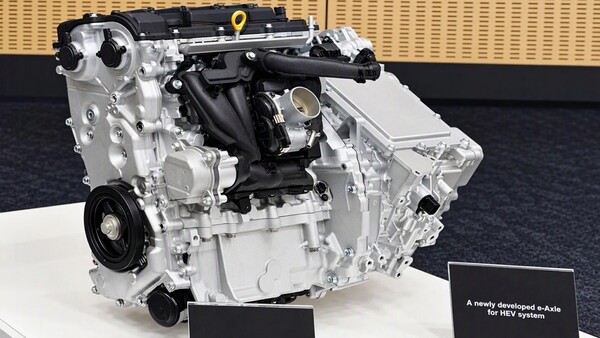
[DigitalToday reporter Jae-won Choi] Toyota of Japan is developing a next-generation hybrid engine, aiming to improve fuel economy by more than 15 percent. It plans to cut size and weight versus existing engines while designing EVs and hybrid vehicles to share a platform, seeking production efficiency and cost competitiveness at the same time.
InsideEVs reported on Oct. 29 that Toyota recently unveiled a new 1.5-litre four-cylinder gasoline engine to be used in hybrids (HEVs) and plug-in hybrids (PHEVs).
The new engine will be developed in two versions: naturally aspirated and turbocharged. The naturally aspirated model, in particular, is designed to replace the performance range covered by the existing 1.8-litre engine and the 1.5-litre three-cylinder engine.
Rather than upgrading existing internal combustion engines, Toyota designed the engine, electric motor, hybrid system and power control unit from the outset as a single integrated powertrain.
The key is to raise energy efficiency by reducing mechanical friction and electrical losses and improving thermal management. It will also apply a smaller, lighter electric motor and silicon carbide (SiC)-based power semiconductors.
Toyota aims to combine these technologies with reduced vehicle aerodynamic drag to raise fuel economy by more than 15 percent compared with existing hybrid vehicles. It said the figure has not been achieved in actual mass-produced vehicles.
The new powertrain will be installed on Toyota's Multi Pathway platform under development. The platform features a body structure designed with battery electric vehicles as the priority while also allowing hybrid and plug-in hybrid systems to be applied.
As the engine and powertrain become lower in height, the hood can be designed lower. That also makes it possible to adopt body designs that reduce air resistance while maintaining cabin space.
Sharing the platform is also expected to reduce production costs. That is because it can spread investment for development and production of EVs and hybrids and flexibly adjust the production mix depending on market demand.
Toyota is developing the new engine to be compatible with renewable fuels and carbon-neutral fuels. It is seen as a move to strengthen its existing electrification strategy of pursuing various power sources, including hybrids as well as EVs.
 Jae-won Choi
ittt_0801@d-today.co.kr