
Korea Advanced Institute of Science and Technology (KAIST) is organising an event to share students' experiences of failure and take an advance look at risks that could arise in the era of artificial intelligence (AI).
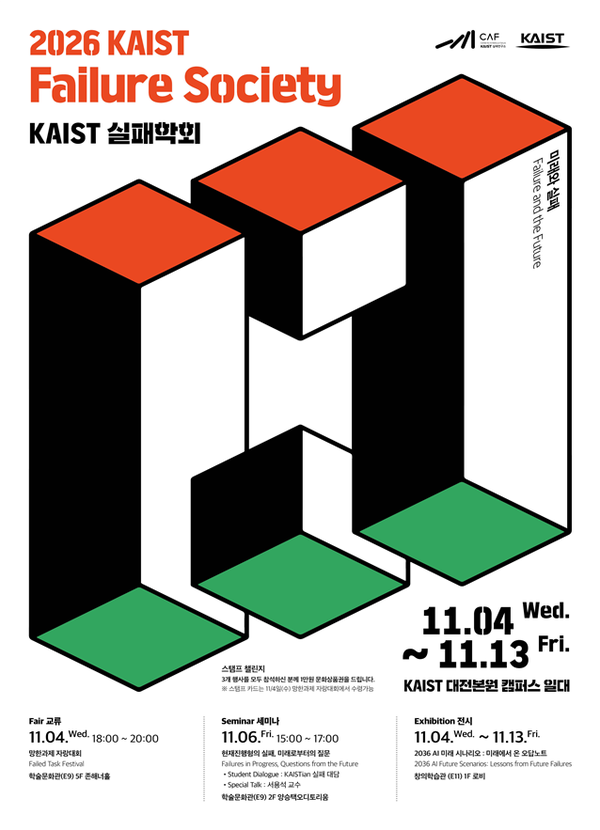
KAIST said on Thursday it will hold the fourth KAIST Failure Conference from Nov. 4 to 13 under the theme "Future and Failure."
A "failed projects bragging contest" will be held on Nov. 4 at John Hannah Hall in KAIST's Academic and Cultural Center. It is an expo where students present failure experiences from study, research and daily life through photos and videos. The audience will vote to select winning teams in 5 categories.
On Nov. 6, a failure seminar will be held at the Yang Seung-taek Auditorium in the Academic and Cultural Center under the theme "Failures in progress, questions from the future."
In the first session, 3 students who won an essay contest on failure will share trial and error they experienced in research and career paths. In the second session, Yongseok Seo (서용석), a professor at KAIST's Moon Soul Graduate School of Future Strategy, will share capabilities required of humans as AI advances and issues that society and institutions will face, under the theme "Why failure matters to humans as AI gets smarter."
During the event, an exhibition titled "2036 AI Future Scenarios: Wrong-Answer Notes From the Future" will also be held at the Creative Learning Building. It will introduce an "AI Future Risk Map" that visualises AI-related failure cases and future risks imagined by citizens.
KAIST will also release a book titled "Tense of Failure" that includes 16 award-winning failure essays, along with a report analysing 429 AI future failure scenarios submitted by citizens.
The report addresses concerns that not only AI malfunctions but also, even if AI works as intended, opportunities for human judgement and learning could diminish or it could become unclear where responsibility lies.
KAIST President Chung-sik Bae (배충식) said, "A university should be a place that respects and learns from trial and error in the process of taking on challenges." He added, "I hope this failure conference becomes a place to gain the courage for the next challenge from each other's experiences and to think together about problems we will face in the AI era."
All programmes are open to anyone. The 2 publications will be made available as e-books through the KAIST Failure Institute website.
 Jin-ho Lee
jhlee26@d-today.co.kr