
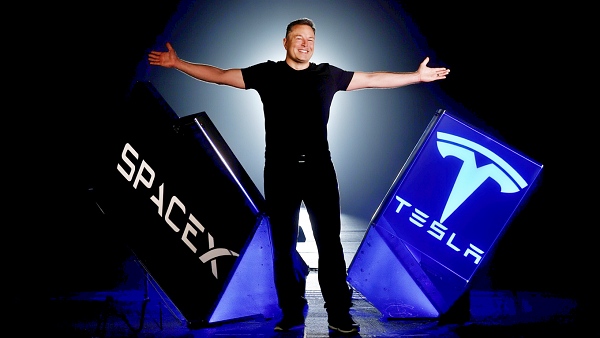
[Digital Today reporter Yoonseo Lee] Elon Musk has formally raised the possibility of a merger between SpaceX and Tesla. If the merger happens, it would combine not only artificial intelligence (AI) and space and robotics businesses, but also 30,221 bitcoin held by the two companies.
On Oct. 21 (local time), blockchain outlet Decrypt reported that Musk said during SpaceX’s third-quarter earnings presentation that each company’s board has formed an independent special committee of directors to review the possibility of a merger. He said they had not agreed on specific deal terms and drew a line by saying it would be an exaggeration to treat a merger as a done deal.
If completed, the merger would create an integrated company with an enterprise value of $3.5 trillion, or about 4,646.25 trillion won. The structure would combine the AI chatbot Grok and social media platform X (formerly Twitter) and satellite internet service Starlink with Tesla’s robotaxi and humanoid robot Optimus. The Terafab chip project and the Starmind orbital data centre plan would also be included in the integrated business.
The plan follows a recent run of affiliate integrations. Musk’s AI startup xAI acquired X around March 2025, and SpaceX acquired xAI at a valuation of $250 billion in February before carrying out an initial public offering (IPO) in June.
The core business is Starmind, which aims to build an AI data centre in space. SpaceX has asked U.S. regulators to approve the deployment of up to 1 million satellites for the project. Musk has forecast deployment starting in late 2027 and expanding to a meaningful scale in 2028, but SpaceX warned in its listing documents that orbital AI computing technology has not yet been proven and may fail to secure commercial viability.
Tesla will supply chips needed for Optimus, the Cybercab robotaxi and the space data centre through a $16.8 billion Terafab that the companies are building jointly in Texas. SpaceX is already leasing computing resources from its AI server farms to Anthropic and Google, among others, and this business also contributed to improved profitability in the third quarter.
The scale of the two companies’ bitcoin holdings is also drawing attention. Tesla disclosed 11,509 BTC in a recent quarterly report, and SpaceX disclosed 18,712 BTC in a securities filing submitted ahead of its IPO. Their combined holdings total 30,221 BTC, worth $2.5 billion, or about 3.32 trillion won, using a bitcoin price of about $83,000.
In particular, the bitcoin holdings disclosed by SpaceX were more than double the amount identified in existing blockchain tracking data. If the merger happens, the holdings of both companies would be reflected in a single set of financial statements. Neither company disclosed any plans to buy or sell additional bitcoin in relation to the merger talks.
Shareholder approval remains a hurdle to completing the merger. To win approval, the deal would need support equivalent to 50 percent of Tesla’s total free-float shares, and Musk also assessed it as a fairly high bar. Tesla’s annual general meeting is scheduled for Dec. 3.
Changes in corporate governance are also a variable. Barclays estimated that Musk’s voting rights in the merged company would be about 56 percent. Musk currently holds about 20 percent of Tesla, but he controls most of the voting power at SpaceX through dual-class shares.
Regulatory and geopolitical issues also remain. SpaceX is a key contractor for the U.S. military, intelligence agencies and the U.S. National Aeronautics and Space Administration (NASA), while Tesla has a high dependence on its Shanghai plant in China. Wall Street also responded broadly favourably to the prospect of a merger, but pointed to the deal price shareholders would accept as a key variable.
The core of the talks is an effort to bundle rockets and satellites, AI models, chips, robots and vehicles inside a single company. Whether SpaceX’s orbital data centre plan and Tesla’s chip production base actually link up is expected to determine the practical significance of the merger.
 Yoonseo Lee
yslee@d-today.co.kr