
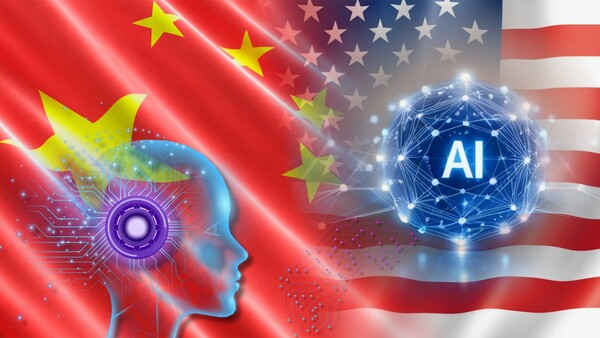
China pushed back and signalled possible countermeasures after the United States banned the use of products from Chinese artificial intelligence startup DeepSeek in federal civilian agencies’ IT systems.
AP and Bloomberg reported on Oct. 21 that the U.S. Department of Homeland Security notified federal civilian agencies to remove DeepSeek products and third-party products and services developed using DeepSeek technology from their IT systems. The move follows an order issued in late July and also bans new procurement of the related products and services.
A notice published in the U.S. Federal Register said DeepSeek models "present multiple threat pathways". It cited concerns that because DeepSeek servers are in China, Chinese authorities could gain access to private-sector infrastructure and sensitive U.S. data. DeepSeek's open-source models are widely used in many countries including the United States, and are mostly provided for free.
Asked about the matter, Chinese Foreign Ministry spokeswoman Mao Ning (마오닝) said China would "resolutely safeguard the legitimate rights and interests" of Chinese companies. She added that China consistently opposes the excessive expansion of the concept of national security.
China's commerce ministry also expressed "strong dissatisfaction and firm opposition" to the U.S. move. It said the United States ignored an agreement between Chinese President Xi Jinping and U.S. President Donald Trump and overlooked the overall state of China-U.S. economic and trade relations. It added that the United States was trying to contain China by imposing discriminatory restrictions under the pretext of national security, and said China would take all necessary measures to protect its legitimate rights and interests.
The dispute shows U.S.-China AI competition is expanding into government systems and public procurement. The United States is restricting China from accessing cutting-edge AI semiconductors and chipmaking equipment. It has also claimed that Chinese AI startups such as DeepSeek carried out "distillation" to extract performance at scale from advanced U.S. AI models, but China denied this. China also put forward measures last week to restrict exports of some advanced AI models.
The two countries have made some progress in AI governance cooperation, including a proposal to build a notification system for national security-related incidents, but they remain at odds on multiple issues. George Chen (조지 첸), head of the digital practice at Washington-based consulting firm the Asia Group, said the warning shows the "depth of strategic mistrust" between Beijing and Washington.
AI is expected to be a key agenda item at a planned meeting between the U.S. and Chinese leaders on the sidelines of an Asia-Pacific Economic Cooperation (APEC) summit in Shenzhen, China, in November.
 Seung-a Yoo
ysah@d-today.co.kr