
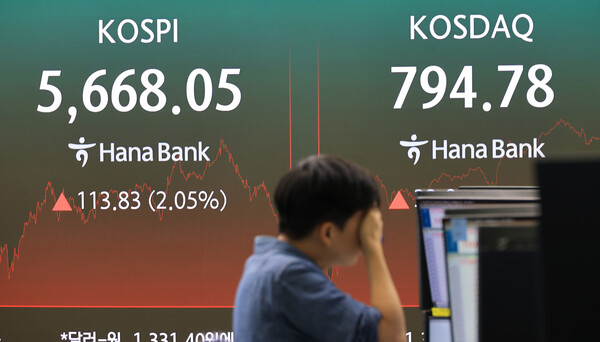
South Korean stocks are expected to test the durability of a rebound this week after a steep fall. With credit risk spreading among artificial intelligence infrastructure companies, the key will be how much big tech earnings and future investment plans ease doubts over AI investment.
According to the Korea Exchange, the KOSPI closed up 2.05 percent at 5,668.05 on Oct. 16, snapping a seven-session losing streak. The KOSDAQ also ended up 4.46 percent at 794.78.
Foreigners net bought 343.5 billion won worth of KOSPI shares as they moved to buy at lower prices. But with the KOSPI having plunged 7.57 percent on Oct. 15, it is hard to say investor sentiment has fully recovered.
U.S. stocks fell again, led by technology shares. On Oct. 16, the Dow Jones Industrial Average closed down 0.34 percent at 52,002.41. The S&P 500 fell 1.09 percent to 7,659.44 and the Nasdaq dropped 2.14 percent to 26,140.03.
Concerns about credit risk tied to AI investment are at the center of the recent plunge. With financing costs rising amid high inflation and interest rates, financial burdens at highly leveraged AI infrastructure firms such as CoreWeave have come into focus.
With credit strains growing, including CoreWeave corporate bond yields topping 15 percent, selling spread across the AI value chain including Oracle, servers and semiconductors. Global hedge funds also reduced AI-related positions, increasing volatility.
Still, the industry view is that it is too early to see the recent correction as the result of a collapse in AI demand itself. TSMC earnings and U.S. industrial output suggest real demand remains intact, centered on data centers and advanced semiconductors.
It is instead described as closer to a reassessment process, as high expectations for future profits and a borrowing-dependent investment approach meet high interest rates.
Corporate earnings this week will test those concerns. Major companies including Netflix and General Motors begin reporting on Oct. 20, followed on Oct. 21 by Tesla, Texas Instruments and Lam Research. The market is also expected to focus on results and guidance from companies closely tied to AI investment such as Meta and IBM.
It may not be enough simply for revenue and profit to beat forecasts. So far, S&P 500 third-quarter results show strong earnings growth, but the market is placing greater importance on whether corporate capital expenditures translate into actual cash flow and profits.
Recently, some companies have seen their shares weaken after earnings even when results exceeded expectations, increasing the importance of forward guidance, valuation and financing costs.
Events to check investment efficiency in the AI industry will also continue. Nvidia GTC will be held in Berlin from Oct. 20 to 22, and Nvidia Chief Executive Jensen Huang (젠슨 황) will deliver a keynote speech on Oct. 21. The next directions for investment in the AI industry, including accelerated computing, agent AI, robotics and physical AI, are set to be unveiled.
The market is expected to focus in particular on whether AI investment is translating into actual productivity gains and revenue growth. With AI investment continuing to rise, if the effects fall short of expectations, additional adjustments could appear, especially among companies with heavy borrowing burdens.
Conversely, if cash-rich big tech firms show both expanding investment and improving profitability, it could provide a catalyst for a rebound in semiconductor and AI-related shares that have fallen sharply.
China’s data and U.S. Treasury yields are additional variables. China releases key economic indicators this week, including third-quarter gross domestic product.
The market sees China’s third-quarter economic growth coming in around 4.4 percent year on year. Depending on domestic demand and industrial production in China, investor sentiment toward domestic materials and industrials and China consumer-related shares could also be affected.
In the United States, as the Federal Reserve enters its blackout period ahead of the Federal Open Market Committee meeting, the importance of bond-market supply and demand is expected to grow, including a U.S. 20-year Treasury auction on Oct. 21.
With U.S. inflation recently coming in higher than expected and rate-hike concerns rising again, a further rise in long-term yields would add to the burden on borrowing-dependent AI companies.
Semiconductor shares have plunged recently due to AI credit risk and foreign selling, but signs that memory prices and AI server demand themselves have been damaged remain limited. If big tech earnings this week confirm that AI investment is being maintained, large-cap semiconductor shares that posted steep declines could be at the center of a rebound.
Still, volatility remains high, making it difficult to expect a V-shaped rebound in the short term. The industry view is that while the KOSPI’s 12-month forward price-to-book ratio has fallen to around 1 and the price-to-earnings ratio has also entered a historical low zone, low valuations alone will not easily revive buying interest immediately.
Ultimately, the key for stocks this week is whether big tech can prove investment continuity through earnings and cash flow while credit risk at AI companies eases. If AI demand holds and long-term yields stabilize, the KOSPI could recoup more of last week’s steep losses.
If credit spreads widen again and earnings outlooks are also shaken, high volatility could continue.
Seo Sang-young (서상영), a managing director at Mirae Asset Securities, said, "The recent correction has more of the character of a reassessment of a high future-profit expectation and a borrowing-dependent investment model, rather than a collapse in demand across the AI industry." He said, "Differentiation is expected to widen between companies with strong cash generation that can shoulder AI investment on their own and companies with high dependence on borrowing."
Kim Jong-min (김종민), a senior research fellow at Samsung Securities, said, "It is difficult to expect a V-shaped sharp rebound in the short term, but the worst negative factors have already been largely priced into share prices." He said, "A strategy of approaching step by step after confirming the formation of a solid downside support line is valid."
Noh Dong-gil (노동길), a research fellow at Shinhan Investment Corp, said, "What the stock market is waiting for is whether it can trust next year’s earnings." He said, "If doubts ease over time and gaps in supply and demand are filled, it could raise its bottom."
 Sangyeop Oh
yub@d-today.co.kr
Sangyeop Oh
yub@d-today.co.kr