
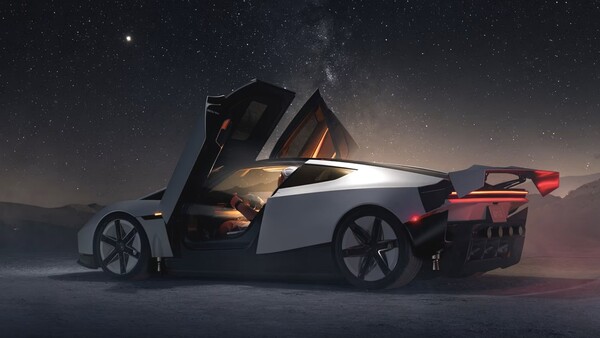
Tesla said the new Roadster can refill its compressed-air tank on its own, but it did not disclose how long recharging takes or how many times it can be used continuously. InsideEVs, an electric-vehicle media outlet, reported on Oct. 16 that the Roadster replenishes the tank by collecting ambient air, compressing it and storing it again.
The Roadster comes in three versions: Performance, Thrust and Rocket. All three models have a suction fan that keeps the body pressed to the road. Thrusters, however, are included only on higher models. The base Performance version has no thrusters, while the limited-availability Thrust adds a rear-facing booster to assist acceleration.
The Rocket version, available only by invitation, is equipped with all 10 thrusters needed for takeoff and aerial attitude control. This model is a single-seater. Being placed in the reservation queue does not mean everyone can use the full flight specification.
Tesla said at a demonstration event that the flight configuration includes two pressure vessels with a total capacity of 600 litres and about 250 kg of compressed air. The figures reflect the settings used for the flight demonstration, but it has not been confirmed whether the same configuration applies to the Thrust version.
The thrusters do not burn fuel. They work by injecting compressed gas. Air is expelled backward to push the car forward, while other nozzles lift the body or control aerial attitude. As air is used, the car becomes lighter, but the pressure needed for thrust also falls. That is why repeat performance depends not only on remaining battery charge but also on the amount of air left.
Elon Musk said the Roadster can refill the tank by itself without a special propellant. Compressing air requires power, however, and using the function could reduce driving range.
The issue is how many times it can be used in practice. Tesla did not disclose recharge time, compressor output, or how many takeoffs are possible before the tank must be refilled. It also did not reveal how quickly compressed air is consumed.
A short acceleration assist may not empty the tank immediately. Situations requiring sustained thrust, such as takeoff or hovering, are different. It is still unclear how many consecutive takeoffs are possible with a full tank, or how long the vehicle can remain in the air.
The suction fan, by contrast, operates separately from the air tank for the thrusters. It draws in air from beneath the car to create downforce and increase grip. Because the device runs on battery power, added grip can be maintained even as compressed air runs down.
 Hyunwoo Choo
cookinpapa@d-today.co.kr
Hyunwoo Choo
cookinpapa@d-today.co.kr