
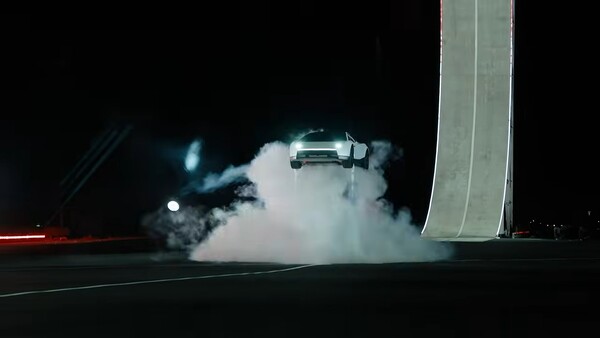
Tesla has unveiled an electric sports car Roadster that can fly, raising questions about whether it can actually be driven on public roads.
On Oct. 16, InsideEVs reported that Tesla demonstrated the flight performance of the second-generation Roadster a day earlier at a SpaceX facility near Waco, Texas. At the site, the Roadster reversed up a curved ramp and then landed using thrusters. Tesla also released footage of the car spinning in mid-air while jumping over multiple Tesla vehicles. No driver was in the demonstration vehicle for safety reasons.
The core technologies are an underbody suction fan and SpaceX cold-gas thrusters. The suction fan helps the car drive upside down by pressing the body to the road surface with up to 2G of force. The thrusters accelerate the car or control its attitude in the air by spraying compressed gas. Tesla claimed in the demonstration that it accelerated from a standstill to 60 miles per hour in 0.81 seconds.
But whether it can be driven on public roads remains unclear. Elon Musk (일론 머스크), Tesla's CEO, said immediately after the demonstration, "The Roadster will be a car that drives on real roads," but added, "I am not sure it will be legal to operate everywhere." When an audience member asked the same question, Musk avoided a definitive answer, saying, "It depends on what road."
Tesla has classified the new Roadster into Performance, Thrust and Rocket versions. The Rocket model, which has flight capability, has not been approved for public-road driving and is distinguished from the Performance model for regular roads.
The Roadster has been repeatedly delayed since it was first unveiled in 2017. Tesla has set 2028 as its production target but did not disclose the sales price. Whether the Roadster, which drew attention for its flight performance, can lead to mass production and road driving remains a key question.
 Choi Jae-won
ittt_0801@d-today.co.kr
Choi Jae-won
ittt_0801@d-today.co.kr