
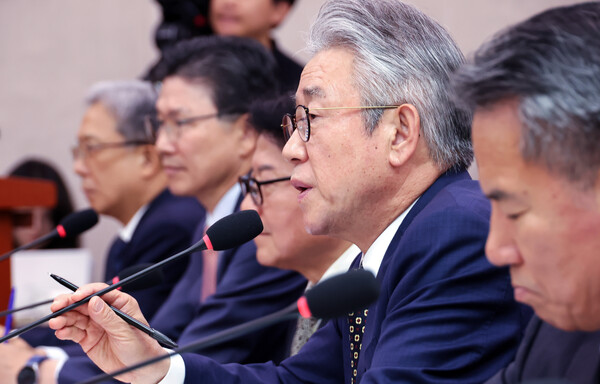
Weakness in mutual finance at local agricultural and livestock cooperatives, including a joint-loan delinquency rate above 17 percent, was singled out during a parliamentary audit. An analysis also found more than 90 percent of total estimated losses came from loans to non-members and quasi-members. As the number of cooperatives unable to pay dividends rises, some loss-making cooperatives were cited for paying executive performance bonuses, prompting criticism of the National Agricultural Cooperative Federation's oversight and supervision.
At the National Assembly's Agriculture, Food, Rural Affairs, Oceans and Fisheries Committee audit of the National Agricultural Cooperative Federation and others on Thursday, lawmakers also focused on bad real estate-related loans at local cooperatives, internal controls and the effectiveness of supervision of poorly run cooperatives.
Joint-loan delinquency at 17.5 percent; problems concentrated in non-member lending
Data presented at the audit by Lee Gae-ho (이개호), a lawmaker from the Democratic Party, showed mutual finance lending at local cooperatives totaled about 385 trillion won. The delinquency rate was 2.46 percent for member loans and 7.46 percent for non-member loans. The non-member delinquency rate was about three times higher than that for member loans.
Of total estimated losses of 1.33 trillion won from bad loans, losses from non-member loans accounted for 59 percent. Another analysis said the share reaches 90.7 percent when quasi-member loans are included.
The delinquency rate for joint loans by local cooperatives linked to real estate development project financing (PF) was presented as 17.5 percent. That compares with an overall delinquency rate of 0.53 percent for NH NongHyup Bank cited during the audit.
In questioning, Lee said it was difficult to explain the high delinquency rate at local cooperatives solely by a downturn in the real estate market. He said screening and post-loan management for joint loans should be strengthened.
He also proposed lowering the threshold for amounts subject to joint-loan screening and introducing an early warning system under which warnings and restrictions on credit handling would be triggered if delinquency exceeds a certain level.
Kang Ho-dong (강호동), chairman of the National Agricultural Cooperative Federation, replied: "We are pursuing various measures to reduce delinquent loans at local agricultural cooperatives." He added: "In particular, we are expanding funding support for handling bad loans and responding by creating a bad-loan fund worth about 500 billion won."
Lee stressed that beyond post-facto cleanup of bad loans, institutional measures were needed to prevent new bad loans in advance.
Another Democratic Party lawmaker, Lee Jae-kwan (이재관), said: "Among joint loans, joint loans by regional agricultural cooperatives amount to 17 trillion won. More than half, over 8 trillion won, is concentrated in real estate investment in the Seoul metropolitan area, and the delinquent amount exceeds 30 percent." He added: "If it had been properly managed in advance, would the cause of such extensive financial weakness have emerged? These areas are part of what needs reform."
107 cooperatives unable to pay dividends; 64 loss-making cooperatives paid executive bonuses
Weak management at local cooperatives and executive compensation systems were also cited as problems.
Data presented by Lee showed the number of agricultural and livestock cooperatives that failed to pay dividends increased to 107 last year from 8 in 2021. There were 40 cooperatives that failed to pay dividends for 2 consecutive years in 2024 and 2025, and 3 that failed to pay dividends for 5 years since 2021.
Some lawmakers said no separate management improvement measures were taken at some cooperatives that were unable to pay dividends for a prolonged period.
Among 76 cooperatives that posted losses, 64, or 84.2 percent, paid executive performance bonuses.
Lee said the federation's oversight of loss-making cooperatives was insufficient and questioned the appropriateness of executive bonus payments and management improvement measures. He also cited retirement payments made during mergers involving cooperatives deemed at risk of weakness.
Lee said: "There are Uiseong Nonghyup and Uiseong Jungbu Nonghyup, which merged in July this year. Even though they failed to pay dividends and recorded losses for the 2 years before the merger, a retirement payment of 80 million won was paid to the cooperative head." He asked: "Is the audit function working properly?"
Lawmakers said control over weak cooperatives was inadequate even though the federation has oversight tools including audits, management diagnostics and funding support.
Financial incidents total 96.1 billion won; dispute over introducing an independent audit body
Questions also continued over weak internal controls at the federation.
Democratic Party lawmaker Lim Mi-ae (임미애) said financial incidents at agricultural and livestock cooperatives over the past 5 years totaled 96.1 billion won, and that half of embezzlement cases were uncovered through external tips rather than internal audits.
She also highlighted that 65 inappropriate cases were identified in a government special audit and a joint cross-government audit, and 14 of them were referred for investigation.
Lim said a legally independent cooperative audit committee had a structure of reporting to the federation's personnel line, arguing that existing audit systems had limits in internal controls.
A rebuttal followed that the Ministry of Agriculture, Food and Rural Affairs should first check whether it fully exercised its existing supervisory authority.
According to data presented at the audit, the ministry took no action against executives in audits of the federation over the past 5 years, but carried out 19 actions related to executives and staff this year, including 7 actions against executives.
Another criticism was raised that strong supervisory powers set out in the Agricultural Cooperatives Act, including cancellation of resolutions and business suspension, have not been exercised in the past 6 years.
Opinions also diverged over a plan to set up an independent audit body outside the federation.
Kang acknowledged the need for reform at the federation and said he would come up with reasonable measures for reform proposals being discussed by the government and the National Assembly.
 Ji-young Lee
ljy@d-today.co.kr
Ji-young Lee
ljy@d-today.co.kr