
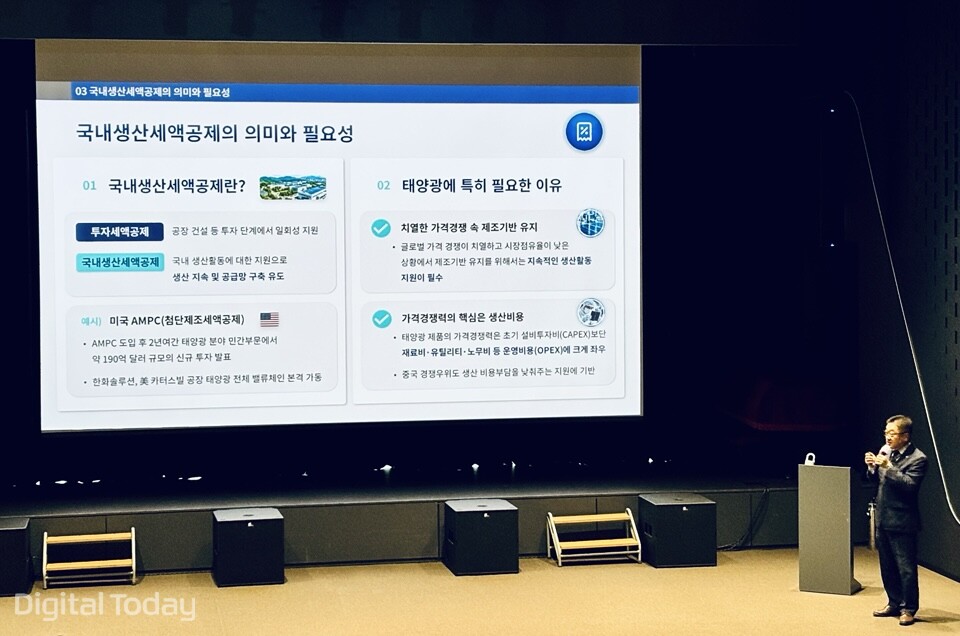
The solar industry is asking the government to introduce direct pay as it pushes a domestic production tax credit. The domestic solar cell manufacturing base is crumbling under a Chinese onslaught, but the government plan does not include a refund mechanism that would allow loss-making companies to benefit from the credit.
Yoo Jae-yeol (유재열), head of Hanwha Solutions' Qcells division's Korea business (executive director), said at the Hanwha Solutions Academy on Oct. 15 that the domestic cell manufacturing base is disappearing. Yoo said domestically made cells' market share in South Korea fell to around 3 percent last year from the mid-30 percent range in 2021. With the government setting a target of 100 gigawatts (GW) in cumulative renewable energy deployment by 2030, the market is expanding but domestic cells cannot meet that demand, he said.
China's production capacity lies behind the displacement of domestically made cells, he said. Yoo said the decline in domestic cell market share is also occurring outside South Korea. China has capacity equal to about twice global demand and about three times its own demand, backed by central and local government subsidies, he said.
He said domestic companies also need at least minimal support. The stage the industry points to for support is the cell. Upstream from the cell, polysilicon, ingot and wafer are capital-intensive industries competing on capacity. Cells are the most technology-intensive step in the value chain, and a module's electrical characteristics are determined at the cell stage. It is also the step with the biggest value added, and is cited as a minimum condition for a manufacturing base.
The support measure the industry is calling for is a domestic production tax credit. The Ministry of Economy and Finance included the introduction of a domestic production tax credit in its tax revision plan, and solar is among the eligible sectors. The credit period, requirements and phased reduction structure are almost the same as the U.S. advanced manufacturing production tax credit (45X).
But there are two differences from the U.S. system. The government plan caps the credit limit at 50 percent of cumulative investment, and it does not currently include direct pay and transferability of tax credits that exist in the U.S. system. Chung Gyu-chang said he understands the credit applies only to products produced domestically and sold domestically.
The reason the industry is demanding direct pay in particular lies in the cost structure of solar manufacturing. A cell plant requires capital spending on equipment and continuing operating costs, making it difficult to generate operating profit in the early stages of operation. If direct pay is provided, loss-making companies with no tax to pay can receive the credit amount in cash. Yoo said the United States increased cell production capacity to 11 GW from 0 after introducing 45X, and that Canada, France and Japan are also rushing to adopt similar systems. That is the basis for the domestic cell industry's proposal to the government for a refund structure similar to the U.S. model.
For that reason, the company said the system must be supplemented first for South Korea to get ahead of China and for domestic facilities investment to become more active. The need for direct pay was also raised at a public briefing held on Oct. 7, and President Lee Jae-myung previously instructed officials to review hybrid support combining subsidies and tax credits.
Hanwha Qcells set out a goal of linking the domestic cell base to next-generation products once the system is in place. The company said it has the largest domestic cell and module manufacturing base and can supply immediately when demand increases. It is operating a perovskite tandem cell pilot line at its Jincheon plant and has received certification for a large-area cell efficiency of 28.6 percent. Its goal is mass production of tandem cells and modules by the end of 2028. Yoo stressed that mass-producing tandem products first can eliminate China's advantage in silicon cells.
 Dae-geon Seok
d2dg@d-today.co.kr
Dae-geon Seok
d2dg@d-today.co.kr