
With the institutionalisation of the digital asset market delayed, financial authorities are repeatedly stressing the need to limit major shareholders’ stakes in exchanges, fuelling concerns across the industry.
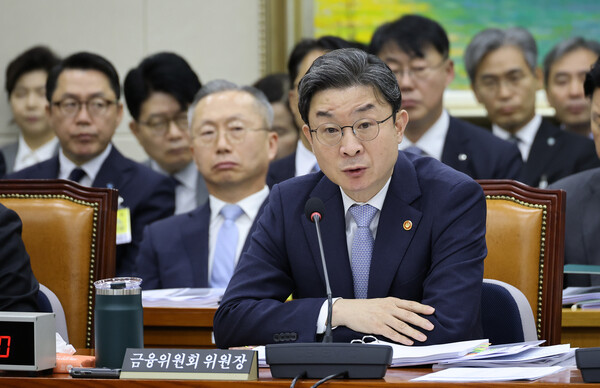
The Financial Services Commission on Oct. 8 again underscored the need for limits on major shareholders’ stakes in digital asset exchanges at a parliamentary audit by the National Assembly’s Political Affairs Committee.
FSC Chairman Lee Eok-won (이억원), speaking about efforts to introduce regulations on exchange stakes, said, "We are drafting a proposal." He said the system would be designed to reflect a range of views during parliamentary deliberations.
The plan under review would, in principle, limit the stake held by an exchange’s major shareholder to about 20 percent. Options also being discussed include allowing up to 34 percent if certain conditions are met, or limiting voting rights rather than the stake itself.
The FSC said a cap for major shareholders has not been finalised. Specific standards, including whether it would apply to existing exchanges and the length of any grace period, have also not been decided.
A problem is that second-stage digital asset legislation itself is being delayed. The current user protection law related to digital assets is in effect, but a second-stage bill covering an exchange licensing system, a business-by-business regulatory framework and stablecoin issuance remains at the stage of coordinating a government proposal.
At the parliamentary audit, Lee said inter-agency consultations are in their final stages and that the government would push for swift legislation, but he did not present a specific time for submitting a government bill.
Regulatory uncertainty is also acting as a variable for financial companies seeking to enter the digital asset market.
A representative example is a comprehensive share swap between Naver Financial and Dunamu. The two companies on Oct. 7 changed the share swap date to March 31, 2027, from Dec. 31. With the schedule, originally set for June 30, being postponed for a third time, completion has been pushed back by 9 months from the initial plan.
The latest delay reflects factors including the Fair Trade Commission’s merger review and financial authorities’ licensing and approval procedures related to a change of major shareholder. Dunamu said there is no change in the transaction’s basic structure and direction.
Still, if a cap on major shareholder stakes is introduced and applied to existing operators, it could affect a structure under which Naver Financial aims to fold Dunamu into a wholly owned unit. Separate from the reviews under way, it would mean also having to consider the possibility of governance changes stemming from new regulations.
Korea Investment & Securities in May decided to make a strategic investment in Coinone together with global digital asset firm OKX Ventures. Each invested 80 billion won to secure 20 percent stakes in Coinone, and on July 22 completed acceptance by the Financial Intelligence Unit of a major shareholder change notification.
Coinone currently has Chief Executive Cha Myung-hoon (차명훈) as its largest shareholder with a 30.4 percent stake, while Com2uS affiliates hold 24.54 percent and Korea Investment & Securities and OKX Ventures each hold 20 percent.
Korea Investment & Securities’ stake matches the currently discussed cap of 20 percent, so even if that standard is adopted as is, it would not become a direct target for divestment. Still, existing shareholders and the exchange’s governance could change, and future additional investment and forms of management participation could be affected depending on the content of the rules.
Mirae Asset Group is in a more sensitive position to regulatory changes because it has directly secured control of an exchange.
Mirae Asset Consulting, the group’s non-financial affiliate, in July acquired a 97.15 percent stake in Korbit to secure management control. In August it also participated in a 50 billion won rights offering to raise capital for expanding its digital asset business.
Mirae Asset Group Chairman Park Hyeon-joo (박현주) met with DigitalX employees on Aug. 26 and laid out plans for a return to profit in 2027 along with an additional capital increase concept.
On the premise of returning to profit, Park presented a plan to pursue a third-party allocation capital increase worth 200 billion to 300 billion won in the first quarter of 2027 for strategic investors.
But if a major shareholder cap is introduced at about 20 percent and applied to existing operators, Mirae Asset Group could face the possibility of having to dispose of a substantial portion of its holdings or adjust its governance structure.
Legal controversy over such regulations is also continuing.
In a review opinion issued on Sept. 21, the National Assembly Research Service said a plan to limit voting rights of exchange major shareholders could also affect constitutionally protected property rights and corporate freedom.
The service said restricting the voting rights attached to shares legally acquired in the past could raise issues including the prohibition on retroactive legislation and the principle of protecting legitimate expectations.
In particular, it raised the possibility that voting-rights limits could excessively increase the influence of the second- and third-largest shareholders, or make it harder to secure control even with additional capital investment, potentially dampening fundraising and mergers and acquisitions.
There were also comments questioning whether financial authorities conducted sufficient prior legal review.
In 자료 submitted in September to the office of lawmaker Park Min-kyu (박민규), the FSC said it had no record of separately conducted legal reviews or advisory work related to limiting exchange major shareholder stake ratios over the past 5 years. Critics say the regulator should sufficiently examine specific legal grounds and policy effects because such rules could affect property rights and management control.
The Digital Asset eXchange Alliance (DAXA) also in January officially voiced concern that limits on exchange major shareholders’ stakes could weaken accountable management and lead to reduced investment across the startup and venture ecosystem.
Financial authorities say governance improvements are needed to strengthen exchanges’ public nature and accountability, but industry participants say a review should come first on whether dispersing ownership can actually lead to better user protection and improved internal controls.
With the share swap between Naver Financial and Dunamu being delayed over a long period while major financial companies including Korea Investment & Securities and Mirae Asset Group proceed with exchange investments, the direction of regulation is expected to be an important variable for future business expansion.
A financial investment industry official said, "Along with the timing of enacting the second-stage digital asset law, the scope of application of major shareholder stake limits, exemption standards and grace periods for existing operators are likely to determine the financial sector’s entry into the digital asset market and whether it makes additional investments."
 Oh Sang-yeop
yub@d-today.co.kr
Oh Sang-yeop
yub@d-today.co.kr