
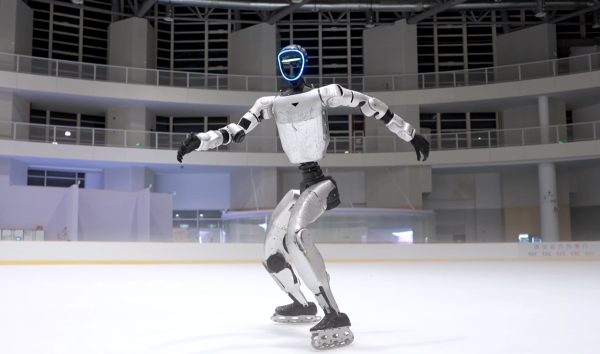
As artificial intelligence rapidly changes how software is developed, a forecast says a technological turning point is also approaching in the robotics industry. Wang Xingxing (왕싱싱), chief executive of Chinese robotics company Unitree, predicted that next-generation AI models could solve key challenges in robot intelligence within 1 to 2 years.
On Oct. 13, IT outlet TechRadar reported that Wang said at an industry event in Shanghai that OpenAI’s latest model, GPT-6 Astra, has raised expectations for a technological breakthrough. He also suggested that a GPT-7-class model that could be released next year may directly solve the problem of embodied intelligence. This refers to technology that enables AI to understand a robot’s body and its surrounding environment and move in response to voice or text commands.
Wang said as recently as August this year that it could take 10 years for the robotics industry’s "ChatGPT moment" to arrive. After checking GPT-6 Astra’s performance, he brought forward his outlook, saying a breakthrough could emerge within 1 to 2 years.
He also proposed a benchmark for judging the maturity of robot intelligence. Robots should be able to perform 80 percent of assigned tasks in 80 percent of unfamiliar environments using only voice or text commands. He explained that meeting this standard would indicate embodied intelligence has reached a sufficiently mature stage.
Unitree is known for advanced robot hardware, but it has recently also stepped up AI software development. Expectations are growing that advances in AI models could narrow the gap between robots’ hardware and software capabilities.
Stanford University’s Movement Lab combined GPT-6 Astra with a Unitree robot and ran an experiment to tidy a kitchen it had never seen before. In the test, the robot tidied the space without environment-specific training data or additional policy learning, and carried out tasks to find and bring back memorised objects based on requests that lacked specificity.
GPT-6 Astra scored 92.7 percent on the ScreenSpot-Pro test, which evaluates AI’s ability to manipulate interfaces. That was higher than GPT-5.6 Sol’s 76.9 percent. Improved model performance is also raising security concerns, and cybersecurity experts are concerned that high-performance AI could be abused to hack other organisations beyond control.
If AI capabilities advance sharply over the next 1 to 2 years as Wang predicted, major changes could also emerge in the robotics industry. The key issues are how much next-generation AI models can improve task performance in unfamiliar environments when applied to real robots, and how well security risks can be controlled at the same time.
 Seung-a Yoo
ysah@d-today.co.kr
Seung-a Yoo
ysah@d-today.co.kr